
Gross Pay vs Net Pay: How Much of Your Salary Do You Actually Keep?
By the Global Income Tax Calculator editorial team · How we source and check these figures
There are two numbers attached to every job, and almost nobody talks about the one that matters. The first is gross pay: the figure in the offer letter, the number you say out loud when a friend asks what the job pays. The second is net pay: what actually lands in your bank account after everyone with a legal claim on your salary has taken their share. The gap between them is often a quarter of your income, sometimes more, and it is the single biggest reason a pay rise can feel smaller than it looked on paper.
This guide explains what gross and net pay really mean, walks through every deduction that sits between them, and shows you how to go from one to the other without guessing. It covers the United States, United Kingdom, India, Canada and Australia, because although the names of the deductions change, the arithmetic almost never does.
Gross pay and net pay, defined properly
Gross pay is your total earnings before any deduction: base salary, overtime, commission, bonuses, shift premiums and most allowances added together. It is a headline figure, not money you ever get to touch. Employers use it because it is stable and comparable — it does not change when your tax code, pension choices or health plan change.
Net pay, also called take-home pay, is what remains after mandatory taxes and any voluntary deductions have come out. It is the number your rent, groceries, loan repayments and savings actually come from. If you build a budget on gross pay, you will overestimate what you can afford by thousands a year, which is exactly how people end up house-poor or car-poor on a perfectly good salary.
One point that trips up a lot of people: gross pay is not the same thing as your employer's cost. On top of your gross salary, employers pay their own contributions — the employer half of social security in the US, employer National Insurance in the UK, employer superannuation in Australia, provident fund contributions in India. That money is real, but it never appears in your gross figure, so ignore it when you are working out net pay.
- Gross pay: everything you earn before deductions.
- Net pay: what actually reaches your bank account.
- Deductions are the difference, and they are rarely a flat percentage.
- Employer contributions sit above your gross pay, not inside it.
Everything that sits between gross and net
Deductions fall into three groups, and it helps to keep them separate in your head. First come income taxes, charged in slices at rising rates — this is the layer people think about most and it is usually not the largest. Second come payroll or social contributions: Social Security and Medicare in the US, National Insurance in the UK, CPP and EI in Canada, the Medicare levy in Australia, Employees' Provident Fund in India. These are often flat-rate and sometimes capped, which means they hit lower earners proportionally harder than income tax does.
Third come voluntary deductions, and these are the ones you actually control. Retirement contributions such as a 401(k), a workplace pension or a superannuation salary sacrifice. Health, dental and vision premiums. Union dues, share purchase plans, cycle-to-work schemes, season ticket loans. Some of these come out before tax is calculated, which quietly reduces your tax bill as well as your net pay; others come out after tax and reduce only your net pay.
That pre-tax versus post-tax distinction is worth more than most raises. A £200 monthly pension contribution taken before tax costs a UK higher-rate taxpayer roughly £120 in take-home pay. The same £200 taken after tax costs the full £200. Nothing about the contribution changed except which side of the tax calculation it sat on.
- Income tax: progressive, charged in slices.
- Payroll or social contributions: often flat, sometimes capped.
- Pre-tax deductions reduce both your taxable income and your net pay.
- Post-tax deductions reduce only your net pay.
How to read a payslip line by line
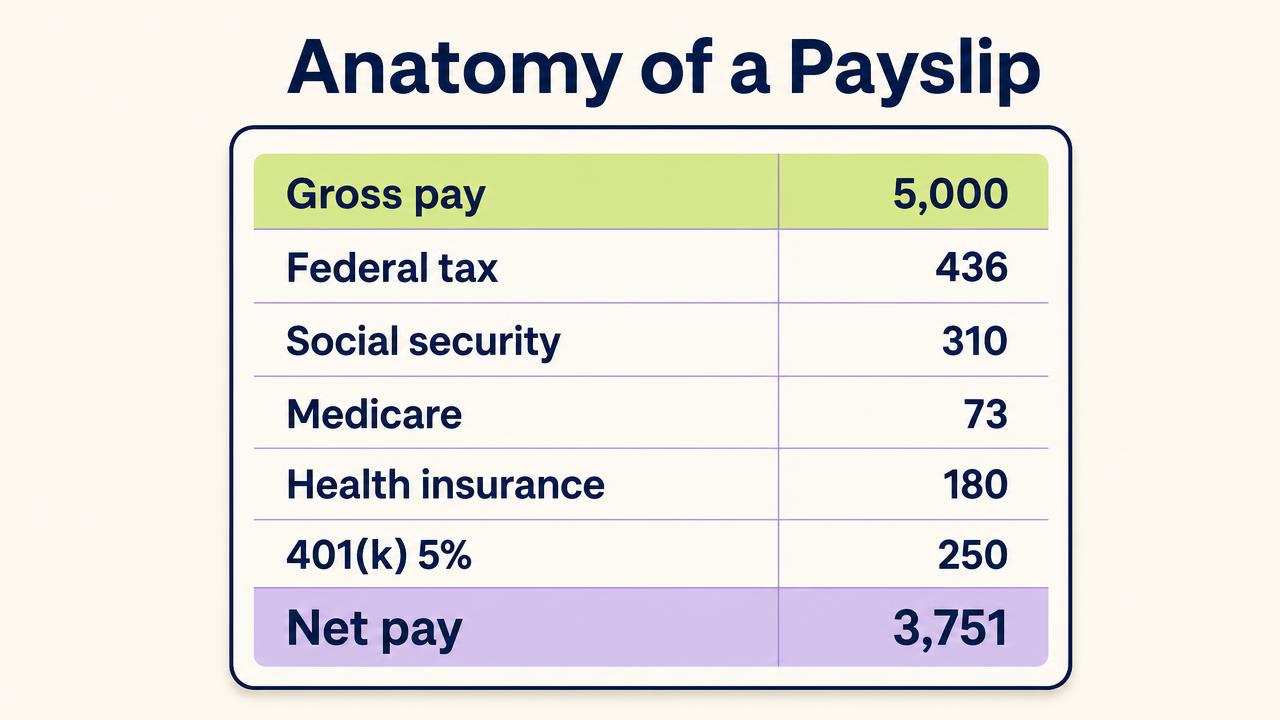
A payslip is really just a small ledger: earnings at the top, deductions in the middle, net pay at the bottom, and year-to-date totals somewhere on the side. Start at the bottom with net pay and check it against your bank statement. If they match, work upwards and make sure every deduction is one you recognise. If they do not match, the problem is almost always a mid-month change — a new tax code, a benefit that started, a bonus taxed at a different withholding rate.
The year-to-date column is the most underused part of the document. Monthly figures bounce around because of bonuses, overtime and threshold effects, but year-to-date totals smooth all of that out. Divide your year-to-date tax by your year-to-date gross and you have your true effective tax rate — a far more useful number than the bracket you happen to sit in.
Two lines deserve a second look every year. The first is your tax code or withholding allowance: a wrong one is the most common cause of over- or under-payment, and it is your responsibility to notice, not your employer's. The second is any deduction labelled with an acronym you cannot expand. If you cannot say what it is for, ask payroll — dormant benefits and legacy schemes quietly drain paycheques for years.
- Check net pay against your bank statement first.
- Use year-to-date totals to find your real effective tax rate.
- Verify your tax code or withholding details once a year.
- Question any deduction you cannot explain.
Working out net pay from a gross salary
The method is the same in every country, and it is four steps. Step one: start with annual gross pay. Step two: subtract pre-tax deductions such as pension or retirement contributions to get your taxable income. Step three: apply the tax brackets slice by slice, then add the payroll contributions on top — noting that payroll contributions are usually charged on your gross pay, not your reduced taxable income. Step four: subtract everything you calculated in step three, plus any post-tax deductions, from your original gross pay. What is left is annual net pay; divide by twelve for a monthly figure.
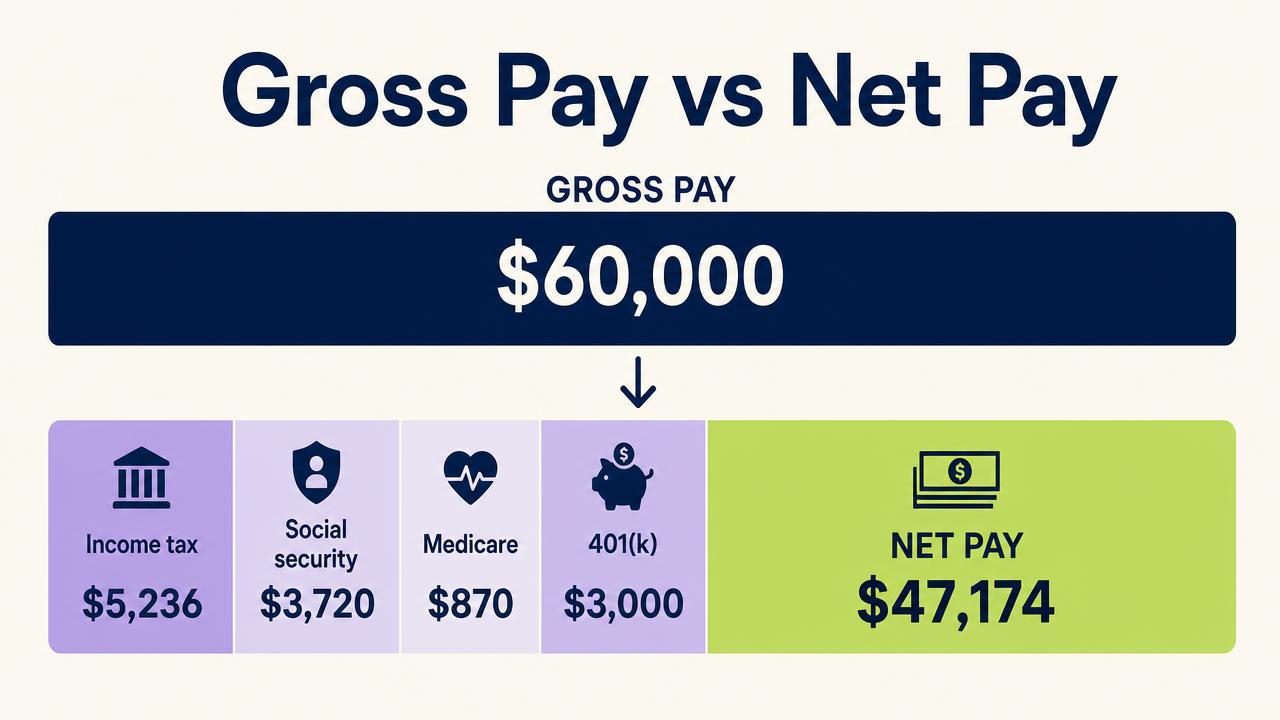
Take a $60,000 US salary with a 5% 401(k) contribution as a worked example. Taxable income after the standard deduction and the retirement contribution lands well inside the 12% bracket, producing roughly $5,236 in federal income tax. Social Security takes 6.2% and Medicare 1.45% of the full gross — about $4,590 combined. The 401(k) removes another $3,000 from take-home pay, though it is still your money. Net pay comes out near $47,174, or about $3,930 a month before any state income tax.
The instinct to shortcut this with a flat percentage is understandable and almost always wrong. Because brackets, allowances and contribution ceilings all interact, a 10% raise can produce anything from a 6% to a 10% increase in net pay depending on exactly where your income sits. That is why guessing is a bad idea and why running your own figures — through the calculator on this site, or by hand if you enjoy that sort of thing — is the only reliable approach.
- Gross pay minus pre-tax deductions equals taxable income.
- Payroll contributions are usually charged on gross, not taxable, income.
- Divide annual net pay by twelve for the monthly figure.
- Never assume a flat percentage — thresholds break the pattern.
Typical take-home percentages around the world
As a rough orientation for a single earner on a middle income with no unusual deductions, take-home pay tends to land between 70% and 80% of gross. In the United States a $60,000 salary keeps roughly 78% federally, before state tax — which can pull it below 73% in California or New York. In the United Kingdom a £45,000 salary keeps about 75% after income tax and National Insurance, falling sharply above £100,000 where the personal allowance tapers away and creates an effective 60% band.
In India the picture depends heavily on which regime you choose and how your CTC is structured, but a ₹12 lakh package under the new regime commonly nets somewhere in the low-to-mid 80% range after tax and provident fund. Canada sits near 75% for a C$70,000 Ontario salary once federal tax, provincial tax, CPP and EI are counted. Australia is close to 74% on A$85,000 after income tax and the Medicare levy, with superannuation paid on top by the employer rather than deducted from you.
Treat these as sanity checks, not answers. Marital status, dependants, region, pension choices and benefit elections can move any of these numbers by five percentage points or more in either direction. Their real value is as an alarm: if your payslip says you are keeping 60% of a modest salary, something is probably wrong and worth investigating.
- US: around 78% of $60,000 federally, less after state tax.
- UK: around 75% of £45,000 after tax and National Insurance.
- Canada: around 75% of C$70,000 in Ontario.
- Australia: around 74% of A$85,000, with super paid on top.
Why gross and net matter in different situations
Use gross pay when you are comparing offers at a headline level, checking market rates, or working out anything defined as a percentage of salary — pension matching, bonus targets, notice periods, severance. It is also the number lenders start from, although they will look hard at your net position before deciding what you can service.
Use net pay for every decision that involves money leaving your account: rent, mortgage affordability, car finance, childcare, subscriptions, savings rate. A useful discipline is to build your budget on net pay and treat gross pay purely as a negotiating unit. It also reframes benefits properly — a job paying 3% less gross but including health cover you were otherwise buying yourself can leave you meaningfully better off in net terms.
The comparison gets genuinely hard when a move crosses borders or regions, because the tax structure changes and not just the rate. A higher gross salary in one country can produce lower net pay than a modest offer in another, and no amount of mental arithmetic will tell you which. That is precisely the case for putting both offers through the same calculator and comparing the take-home figures side by side.
- Gross pay: negotiation, benchmarking, percentage-based benefits.
- Net pay: budgeting, affordability, real comparisons.
- Benefits can outweigh a higher gross figure.
- Cross-border offers must be compared net, never gross.
Three ways to raise net pay without a raise
First, check your tax details. A wrong tax code, an outdated withholding form or an unclaimed allowance is the most common invisible leak in a payslip, and correcting it can produce a refund plus a permanently larger monthly figure. This costs nothing but a conversation with payroll.
Second, move eligible spending in front of the tax line. Retirement contributions, health premiums, childcare schemes and commuter benefits offered through payroll are typically deducted pre-tax, so the same expense costs you less in take-home terms than paying for it yourself afterwards. The higher your marginal rate, the larger that saving becomes.
Third, time variable income deliberately where you can. A bonus, a large commission payment or a freelance invoice landing in a year when your income is already high will be taxed at your top marginal rate. Shifting it, or offsetting it with a pension top-up in the same period, is one of the few legitimate levers an ordinary salaried employee has. None of this is exotic planning — it is just knowing which side of the calculation each pound or dollar sits on, and the fastest way to see the effect is to change one input in the calculator and watch the net figure move.
- Fix an incorrect tax code and reclaim what you overpaid.
- Route eligible costs through pre-tax payroll deductions.
- Time bonuses and top-ups around your marginal rate.
- Model each change before committing to it.