
How Do Tax Brackets Work? What Tax Bracket Am I In for 2026?
By the Global Income Tax Calculator editorial team · How we source and check these figures
Almost everybody has heard the phrase "that would push me into a higher tax bracket", usually said with a wince, usually about a raise or some overtime. It is one of the most persistent misunderstandings in personal finance, and it costs people real money — turning down extra shifts, delaying a promotion conversation, or panicking about a bonus that was never going to be taxed the way they feared.
The truth is calmer and much better news. Moving into a higher bracket does not re-tax the money you already earned, and it never means you take home less than before. This guide explains what a tax bracket actually is, how to work out which one you are in, and why the percentage you really pay is always lower than the bracket you sit in. The examples cover the United States, United Kingdom, India, Canada and Australia, because the underlying mechanism is identical in every one of them.
What a tax bracket actually is
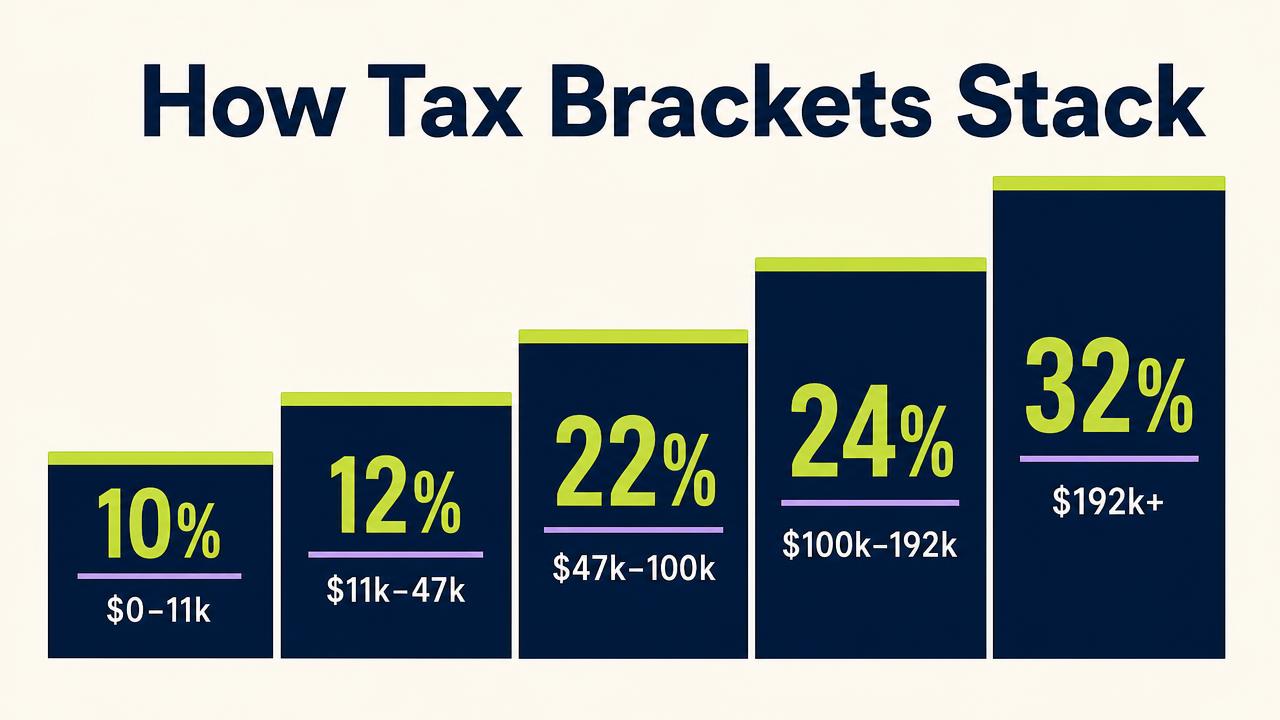
A tax bracket is a range of income that is taxed at one particular rate. Not a category you fall into — a range your income passes through. Every mainstream income tax system in the world is built the same way: your income is cut into slices, and each slice is charged at its own rate. The rates rise as you move up the slices, which is what "progressive taxation" means.
The crucial detail is that the rate attached to a slice applies only to the money inside that slice. When your income crosses into the next bracket, only the pounds, dollars or rupees above that line get the higher rate. Everything underneath continues to be taxed exactly as it was the day before. Nothing is retroactive, nothing is recalculated, and nothing you already earned gets more expensive.
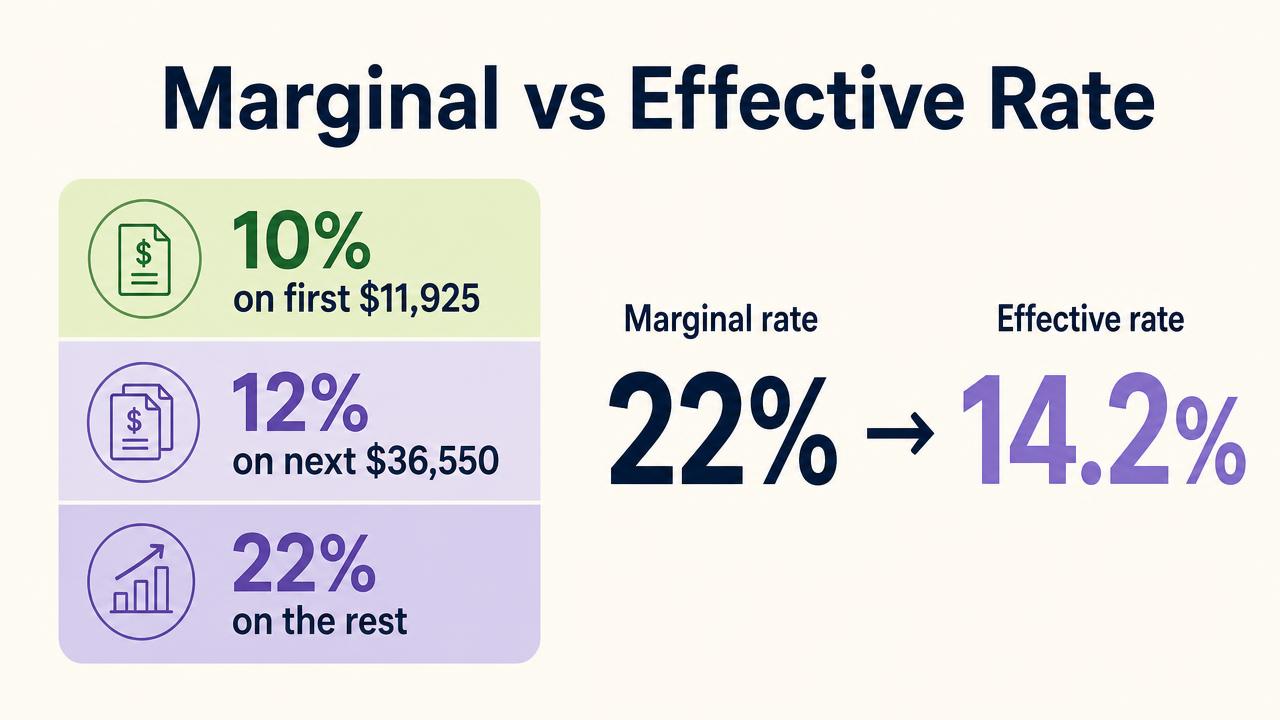
This is why the phrase "what tax bracket am I in?" is slightly the wrong question. You are in several at once. A person earning a solid middle income in the US is simultaneously in the 10%, 12% and 22% brackets — different parts of their salary sit in each. The bracket people usually mean is their top or marginal bracket: the one their last dollar of income landed in.
- A bracket is a slice of income, not a label for a person.
- Each rate applies only to income inside its own slice.
- Crossing into a new bracket never re-taxes income below the threshold.
- Your 'bracket' in everyday conversation means your top bracket.
How to find which tax bracket you are in
Finding your bracket takes three steps, and the first two are the ones people skip. Start with your gross annual income from all sources — salary, guaranteed bonus, freelance profit, taxable interest. Then subtract the amounts that reduce taxable income before rates are applied: the standard deduction in the US, the personal allowance in the UK, the basic personal amount in Canada, the standard deduction under India's new regime, and the tax-free threshold in Australia. Pre-tax pension or retirement contributions come off here too.
What is left is your taxable income, and that is the figure the bracket table applies to — not your salary. This distinction alone moves plenty of people down a bracket. Someone earning $105,000 in the US who contributes 8% to a traditional 401(k) and takes the standard deduction has taxable income closer to $81,000, which lands them comfortably in a lower bracket than a quick glance at their salary suggests.
Step three is to read across the bracket table for your country and filing status and find the row your taxable income falls in. That row's rate is your marginal rate. If you would rather skip the arithmetic, the calculator on this site does all three steps for you and shows the result slice by slice, so you can see which brackets your income actually spans.
Marginal rate versus effective rate: the number that actually matters
Once you know your top bracket, you know your marginal rate — the rate charged on your next unit of income. It is a decision-making number. It tells you what an extra shift, a raise or a pension top-up is worth after tax, and it is the correct number to use whenever you are asking "is this extra money worth it?"
It is a terrible number for describing your overall tax burden, though, and that is where most of the anxiety comes from. For that you want your effective rate: total tax divided by total income. Because the lower slices of your income are still taxed at lower rates, your effective rate is always meaningfully below your marginal rate. Not slightly below — often ten to fifteen percentage points below.
Work through a £60,000 UK salary. The first £12,570 is untaxed. The next £37,700 is taxed at 20%, giving £7,540. The remaining £9,730 is taxed at 40%, giving £3,892. Total income tax is £11,432, which is roughly 19% of gross pay. That person is a 40% taxpayer, and their real income tax rate is about 19%. Both statements are true at the same time, and only one of them is useful for budgeting.
- Marginal rate: use it for decisions about extra income.
- Effective rate: use it to understand your payslip or compare two offers.
- The gap between them is normal, expected and always in your favour.
The raise myth, settled with numbers
Suppose a US worker with $48,000 of taxable income is offered a $4,000 raise, and the top of their 12% bracket sits at $48,475. After the raise, $475 of the new money is still taxed at 12% and the remaining $3,525 is taxed at 22%. The extra tax is $57 plus $776, about $833 in total. They keep roughly $3,167 of the $4,000. Less than the full amount, obviously — but unambiguously more money than before.
There is no arrangement of brackets in any of the five countries covered here where earning one extra unit of income leaves you worse off overall. That cannot happen, because the higher rate only ever touches the new money. What can happen is that a specific benefit, credit or allowance phases out at a threshold, which is a different mechanism entirely and worth knowing about.
The UK has the sharpest example. Between £100,000 and £125,140 the personal allowance is withdrawn at £1 for every £2 earned, which creates an effective marginal rate of about 60% in that band. Australia has HECS-HELP repayment thresholds that step up. The US has credit phase-outs and the additional Medicare tax at higher incomes. India's old regime interacts with deduction limits. None of these make you poorer for earning more — they just make particular bands less rewarding than the headline rate implies, and that is exactly the kind of thing worth checking before you decide where to put a bonus.
Brackets are only half of your deductions
Even a perfect bracket calculation will not match your payslip, because income tax is not the only thing coming out. Sitting alongside it is a second layer of social or payroll contributions with completely separate thresholds and completely separate behaviour.
In the US that is FICA: 6.2% for Social Security up to an annual wage base, plus 1.45% for Medicare with no ceiling at all. In the UK it is Class 1 National Insurance at 8%, falling to 2% above the upper earnings limit. In Canada it is CPP and EI, both of which stop once you hit an annual maximum. In Australia it is the 2% Medicare levy on your whole taxable income. In India it is EPF, typically 12% of basic pay.
Notice the two shapes. Capped contributions take a shrinking share of your pay as income rises, because they switch off at a ceiling. Uncapped ones keep taking the same slice forever. Add state or provincial income tax on top — California, New York and Ontario all run their own bracket tables — and you can easily have three or four independent systems hitting one paycheque. That is the real reason payslips surprise people, far more often than the brackets themselves.
- Income tax brackets are one layer; payroll contributions are another.
- Capped contributions stop at a ceiling; uncapped ones never do.
- State and provincial taxes run their own separate bracket tables.
What to do with this
Three practical habits follow from understanding brackets properly. First, always say yes to more money on tax grounds alone — the only question worth asking is whether the extra work is worth the after-tax amount, which your marginal rate tells you precisely. Second, quote your effective rate, not your bracket, when you are comparing job offers or working out what you can afford; the bracket number will scare you off things you can comfortably manage.
Third, use your marginal rate to price tax-advantaged decisions. A pension or retirement contribution made while you are in a 40% band effectively costs you 60p in take-home pay for every pound saved. The same contribution made in a 20% band costs 80p. Identical contribution, very different value — which is why timing a top-up around a bonus or a high-income year is one of the few genuinely free wins available to an ordinary salaried employee.
Run your own figures through the calculator on this site to see your income broken into its actual slices, with payroll contributions included and your effective rate shown alongside your marginal one. It takes about thirty seconds, and it replaces a vague worry about brackets with two numbers you can actually use.