
How Are Bonuses Taxed? Why Your Bonus Shrank More Than You Expected
By the Global Income Tax Calculator editorial team · How we source and check these figures
Every year, in December and again in March, the same question spikes in search: why did my bonus get taxed so hard? People open their pay statement expecting a $10,000 bonus and find $6,200 in the account. The conclusion almost everyone reaches is that bonuses are taxed at a punitive special rate. That conclusion is wrong, and believing it costs people money — either in unnecessary panic, or in a refund they never realise they are owed.
Here is the point of view this guide is built on: there is no such thing as a bonus tax rate. A bonus is ordinary income, taxed at exactly the same bracket rates as your salary. What is different is the withholding method payroll uses to guess your tax in advance. Withholding is a prepayment, not a tax. Once you separate those two ideas, everything about your bonus payslip becomes predictable.
Below, we walk through both US withholding methods with worked numbers, show what your bonus actually costs you in tax versus what was taken, cover the states that change the answer, and then do the same for the UK, India, Canada and Australia — because the same confusion exists in all of them under different names.
The core distinction: withholding is not taxation
Your annual tax bill is calculated once, at the end of the tax year, on your total income. Every dollar of salary, bonus, commission, overtime and tip is added into the same pile and taxed in slices at your bracket rates. Nothing in that calculation cares whether a dollar arrived as regular pay or as a bonus.
Withholding is a completely separate machine. Its only job is to send an estimated amount to the tax authority every pay period so you are not left with one giant bill in April. Because a bonus is irregular, payroll cannot use your normal pay-period assumptions for it, so tax rules give employers a shortcut. That shortcut is where the mythical bonus rate comes from.
This is why the honest answer to "how much tax will I pay on my bonus?" is: your marginal rate. And the honest answer to "how much will be taken from my bonus?" is: often something quite different. Both answers are correct at the same time, which is exactly why the topic confuses so many people.
- Tax owed on a bonus = your marginal bracket rate, same as salary.
- Tax withheld from a bonus = an estimate, using a special shortcut.
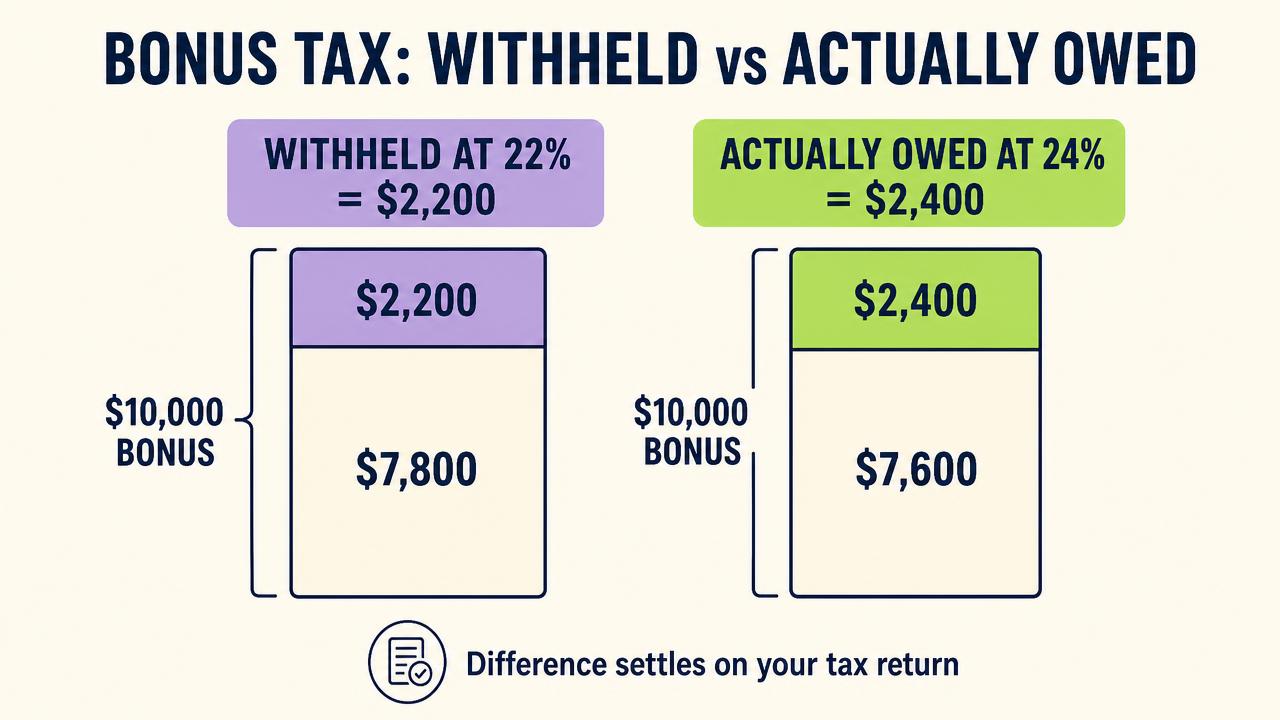
- Any gap between the two settles on your tax return.
- Over-withholding produces a refund; under-withholding produces a bill.
The two US withholding methods, with real numbers
US employers choose between two IRS-sanctioned methods for supplemental wages, and the one your payroll department picked explains almost everything about your bonus payslip.
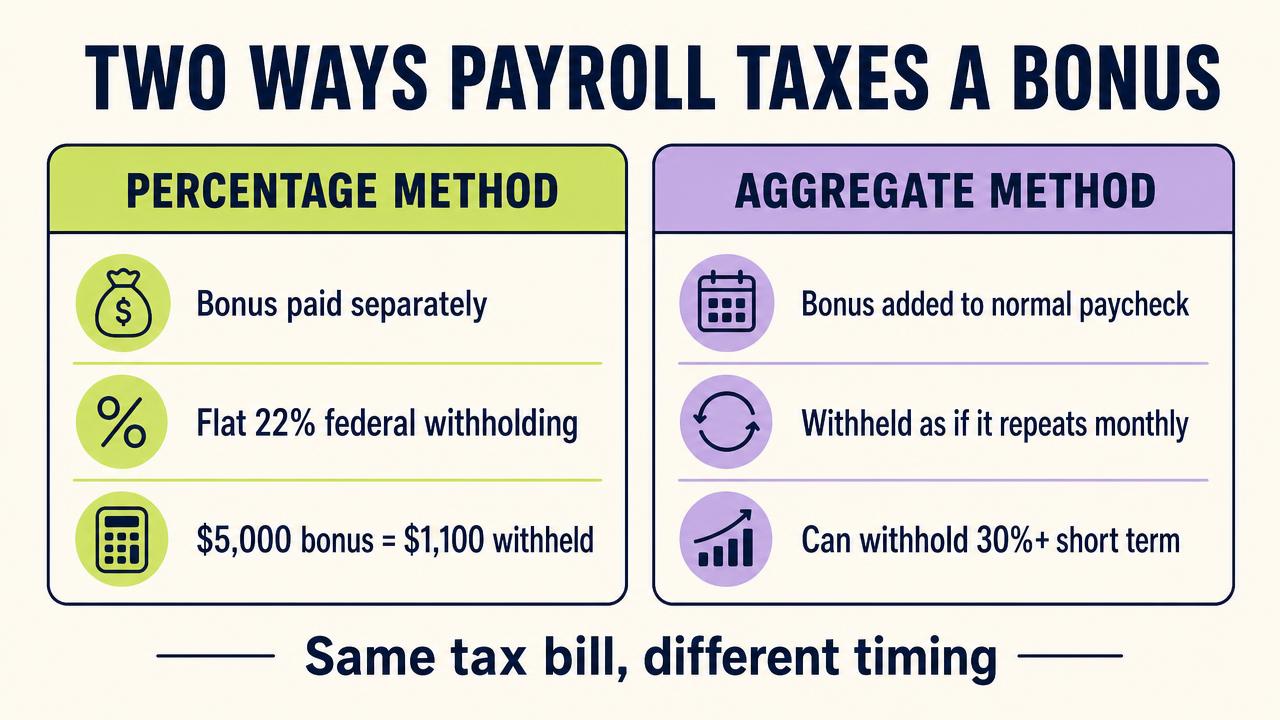
The percentage method applies a flat 22% federal withholding to bonuses paid separately from regular wages, for supplemental income up to $1 million in a calendar year. Anything above $1 million is withheld at 37%. So a $10,000 bonus paid on its own cheque has $2,200 withheld federally, plus 6.2% Social Security ($620, up to the annual wage base), plus 1.45% Medicare ($145), plus any state withholding.
The aggregate method adds the bonus to your regular paycheque and withholds as though that combined amount were your normal pay for every period of the year. If you earn $5,000 a month and receive a $5,000 bonus in the same run, payroll temporarily treats you as a $120,000-a-year earner and withholds accordingly. That can push short-term withholding above 30%, which is why identical bonuses at two different employers can produce very different net figures.
Neither method changes what you owe. If your marginal rate is 24% and 22% was withheld, you are short 2% and will settle it in April. If your marginal rate is 12% and 22% was withheld, you over-prepaid and the excess comes back as refund. That second case is extremely common for people earning under roughly $50,000 — and most of them never realise their bonus generated a refund rather than a tax hit.
- Percentage method: flat 22% federal, 37% above $1M supplemental.
- Aggregate method: withheld as if the bonus repeats every period.
- Social Security (6.2%) and Medicare (1.45%) still apply either way.
- Under-withheld at 24%+? Expect a balance. Over-withheld at 12%? Expect a refund.
Worked example: what a $10,000 bonus really costs
Take a single filer earning $85,000 in salary who receives a $10,000 bonus, paid separately, in a state with no income tax such as Texas or Florida. Federal withholding is a flat $2,200. Social Security takes $620 and Medicare $145, so $7,035 hits the account — about 70% of the headline number.
Now the actual tax. That $10,000 sits in the 22% federal bracket for this filer, so the true federal tax on the bonus is $2,200 — identical to what was withheld. The payroll taxes were owed regardless. In this case the withholding was almost perfectly accurate, and the bonus felt heavily taxed only because payroll taxes and federal tax arrived in the same line.
Change one variable and the story flips. Give the same person a $60,000 bonus and part of it crosses into the 24% bracket, so a flat 22% under-withholds by several hundred dollars. Drop their salary to $40,000 instead and the bonus is largely taxed at 12%, meaning the flat 22% over-withheld by roughly $1,000 that returns as refund. Same rules, three different outcomes — decided entirely by where your total income lands, not by the fact it was a bonus.
This is the calculation worth doing before you spend the money: add the bonus to your expected annual salary, run the total through a calculator, then compare the resulting tax to what your payslips have withheld year to date. That single comparison tells you whether you are owed money or about to owe it.
- $85,000 salary + $10,000 bonus: about $7,035 net, no state tax.
- True federal tax on that bonus: $2,200 — the withholding was accurate.
- Lower salaries usually over-withhold on bonuses and get refunds.
- Large bonuses that cross a bracket usually under-withhold at 22%.
Where you live changes the answer
State rules sit on top of the federal picture and produce genuinely large differences. California applies a supplemental withholding rate of 6.6% to bonuses, and 10.23% specifically to stock options and bonus-type payments treated as supplemental at the higher rate — so a California bonus can show close to 30% withheld before payroll taxes are counted.
New York applies its own supplemental rate and, if you live in New York City, a separate city resident tax as well. That local layer is invisible in every national bonus calculator, and it is why New York City readers consistently report the worst-looking bonus payslips in the country.
Texas, Florida, Washington, Nevada, Tennessee, South Dakota, Wyoming and Alaska levy no state income tax at all, so a bonus there faces only federal withholding plus Social Security and Medicare. On a $10,000 bonus, the spread between a no-tax state and New York City is comfortably over $700 in withheld cash — for the same job at the same salary.
If your state or city matters to your planning, run the numbers on a state-specific page rather than a national one. Our California and New York calculators apply the relevant state brackets on top of the federal calculation so the take-home figure reflects both layers.
- California: 6.6% supplemental withholding, higher for equity-type payments.
- New York City: state supplemental plus a separate city resident tax.
- No state income tax: TX, FL, WA, NV, TN, SD, WY, AK.
- Same bonus, different address: a $700+ swing on $10,000.
Bonuses in the UK, India, Canada and Australia
The UK does not use a flat supplemental rate. A bonus goes through PAYE alongside your salary, and because PAYE annualises the month it is paid in, a large bonus can be temporarily over-taxed and then corrected automatically in later months. The genuine trap is different: a bonus that pushes total income past £100,000 begins withdrawing the personal allowance at £1 for every £2, creating an effective marginal rate of around 60% on that band. A bonus is often what tips someone into it, and a pension contribution in the same tax year is the standard way out.
India taxes bonuses as salary income in the year they are received, with TDS deducted at your average rate rather than a flat supplemental rate. Because employers recalculate TDS across the year, a bonus in the first quarter and the same bonus in the final quarter can produce noticeably different monthly deductions while the annual tax stays identical.
Canada uses a bonus-specific method: employers annualise the bonus to work out which bracket it falls in and deduct accordingly, and CPP and EI apply until their annual maximums are reached. If you have already hit those caps by the time your bonus lands, the deduction on it will be visibly smaller — one of the few cases where a later bonus genuinely nets more.
Australia has a formal schedule for back payments, commissions and bonuses that averages the payment across the relevant period to work out withholding. Superannuation guarantee contributions are generally payable on bonuses classed as ordinary time earnings, which means part of the value shows up in your super rather than your bank account.
- UK: no flat rate, but watch the £100,000 personal allowance taper.
- India: TDS at your average rate, recalculated across the year.
- Canada: bonus annualised for brackets; CPP and EI stop at their caps.
- Australia: averaged withholding schedule, with super usually payable on top.
Five things you can actually do about it
First, ask payroll which method they use. It takes one email and it turns your bonus payslip from a mystery into arithmetic you can check in advance.
Second, if you are in a high bracket and expect to be under-withheld, either put the shortfall aside now or file a revised withholding form so the rest of the year catches up. Discovering a four-figure balance in April is the avoidable version of this problem.
Third, use pre-tax routes deliberately. A bonus directed into a 401(k), a UK pension, an Australian salary sacrifice or an Indian NPS contribution is taxed later rather than now, and in the UK case it can rescue a personal allowance worth far more than the contribution itself.
Fourth, check timing where you have any influence. A bonus paid in a year when your income is unusually low is taxed at a lower marginal rate, and a bonus arriving after you have maxed out capped contributions such as CPP, EI or Social Security keeps more cash in hand.
Fifth, and simplest: model it before you plan around it. Enter your salary plus the bonus as one annual figure, look at the tax owed, and compare it with what has actually been withheld so far. Two minutes of that beats every rule of thumb about bonus tax rates, because it uses your income, your filing status and your location instead of an average of somebody else's.
- Confirm whether payroll uses the percentage or aggregate method.
- Set aside the shortfall if your marginal rate exceeds 22%.
- Route part of the bonus into pre-tax retirement savings.
- Prefer timing where capped contributions are already maxed.
- Model salary plus bonus as one annual figure before spending it.