
Countries With No Income Tax: Where a Six-Figure Salary Actually Stays Yours
By the Global Income Tax Calculator editorial team · How we source and check these figures
Search for countries with no income tax and you will find the same recycled list of eight or nine names, usually with a photo of a skyline and no numbers. That list is technically correct and practically useless, because it answers the wrong question. Nobody actually wants to know which governments skip income tax. They want to know how much of their salary they would keep — and whether the difference survives contact with rent, school fees, visa rules and the cost of getting home twice a year.
This guide takes the opposite approach. We start with the real 2026 list, then immediately show what those countries charge instead, because every zero-income-tax jurisdiction funds itself somehow. Then we run the same $150,000 salary through nine systems so you can see the actual gap between a 0% country, a low-tax country and a high-tax welfare state.
The short version, stated up front so you can stop reading if it is all you needed: moving from a 40%-effective country to a 0% country is worth roughly $45,000 a year on $150,000 — and in several of those destinations, housing and schooling absorb most of it. The tax saving is real. The wealth increase is smaller than the headline suggests.
The 2026 list: countries with no personal income tax
There are around a dozen jurisdictions with no tax at all on personal employment income. They fall into three groups, and the group matters more than the individual country, because each group has a different reason for existing and a different catch.
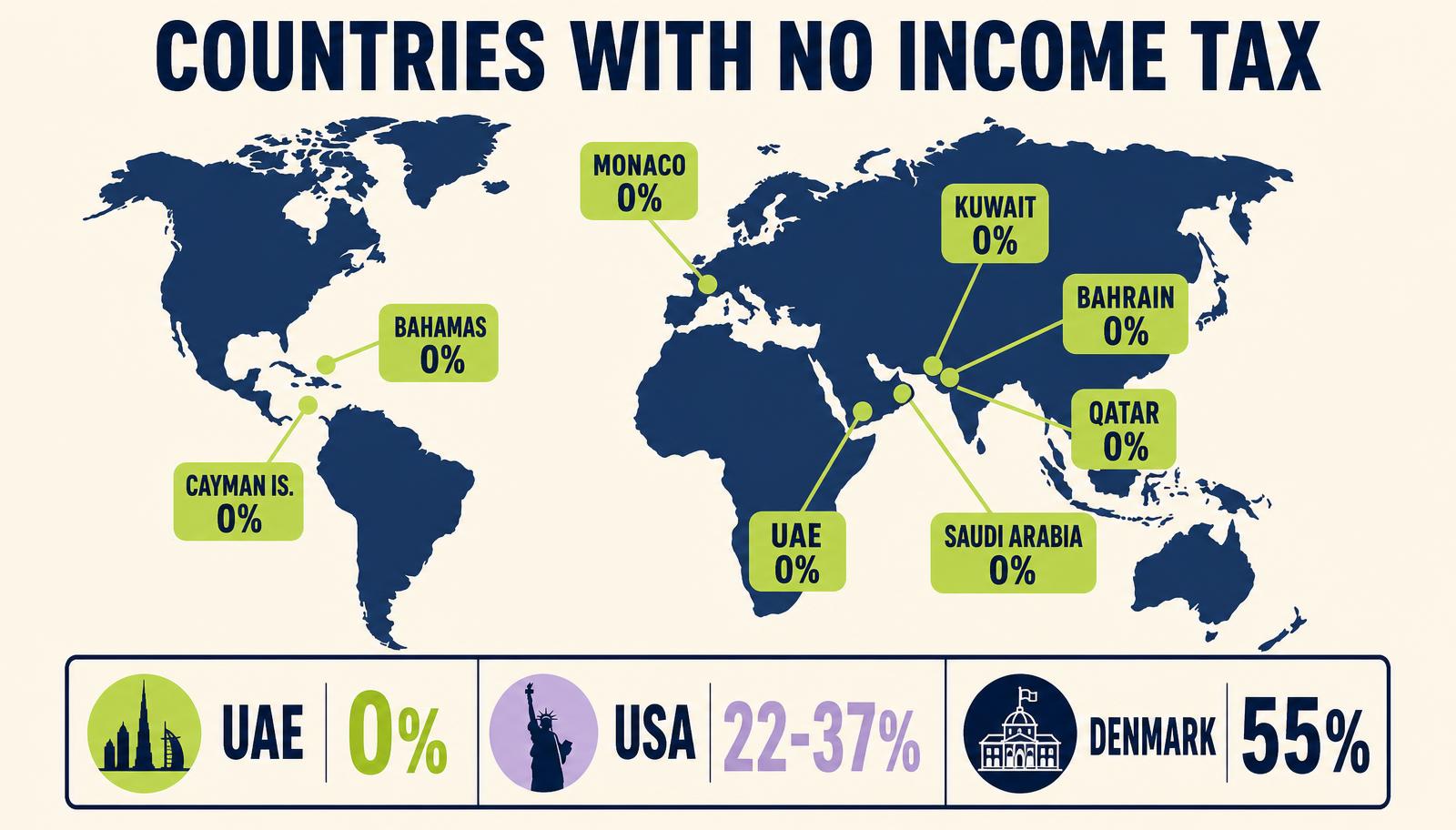
The Gulf states — the United Arab Emirates, Saudi Arabia, Qatar, Kuwait, Bahrain and Oman — levy no personal income tax on salaries. They are the only realistic option for most salaried professionals, because they issue large volumes of employment visas and host genuine job markets in finance, construction, energy, healthcare, aviation and technology.
The Caribbean and Atlantic group — the Bahamas, the Cayman Islands, Bermuda, Anguilla, the Turks and Caicos Islands and Saint Kitts and Nevis — also charge no income tax, but their labour markets are small and heavily protected. Work permits are typically tied to a specific employer and role, and in several of them payroll levies or high import duties recover much of what income tax would have collected.
The micro-state group — Monaco and Vanuatu are the usual examples — charges no income tax but effectively requires either substantial capital or an unusual reason to be there. Monaco's residency route depends on housing and bank deposits, not employment offers.
Two frequent additions to online lists deserve a correction. Brunei has no personal income tax but is rarely a practical destination for foreign salaried workers. And several countries described as tax-free — Singapore, Hong Kong, Panama, Costa Rica, Georgia — do charge income tax; they are simply low-rate or territorial systems, which is a different thing.
- Gulf: UAE, Saudi Arabia, Qatar, Kuwait, Bahrain, Oman — 0% on salary.
- Caribbean/Atlantic: Bahamas, Cayman, Bermuda, Anguilla, Turks and Caicos, St Kitts.
- Micro-states: Monaco, Vanuatu — 0%, but capital-based residency.
- Commonly mislabelled: Singapore, Hong Kong, Panama, Georgia all tax income.
What replaces income tax — because something always does
A government with no income tax still needs revenue, and understanding where it comes from is what separates a useful comparison from a naive one. There are four standard substitutes, and most zero-tax countries use at least two.
The first is resource revenue. Most Gulf budgets rest on hydrocarbon income, which is why the model exists there and not in resource-poor countries of similar size. The second is consumption tax. The UAE, Saudi Arabia, Bahrain and Oman all now levy VAT — 5% in the UAE, 15% in Saudi Arabia — so a share of what you save in income tax returns every time you spend.
The third is fees and duties, and this is the one people underestimate. Visa issuance and renewal, work permits, medical tests, Emirates ID or equivalent, vehicle registration, road tolls, municipality charges on rent, exit levies and import duties on almost everything on a supermarket shelf. In the Caribbean jurisdictions, import duty is the primary revenue source and it is why a familiar grocery basket can cost double what it does in Florida.
The fourth is mandatory employer-side or payroll contributions. Several no-income-tax jurisdictions require pension, social insurance or health contributions that function like a flat tax on employment, sometimes split between employer and employee. Bermuda's payroll tax is the clearest example: no income tax on paper, a substantial payroll levy in practice.
None of this cancels out the advantage. A 0% income tax rate combined with 5% VAT is still enormously better than a 32% effective rate combined with 20% VAT. The point is that your real saving is smaller than the headline, and it varies wildly with how you live — a saver in Dubai keeps far more of the advantage than a family paying international school fees for three children.
- Resource revenue funds most Gulf budgets in place of income tax.
- VAT: 5% UAE, Bahrain and Oman; 15% Saudi Arabia.
- Fees, tolls, permits and import duty recover a large share elsewhere.
- Payroll or social-insurance levies exist in several 0% jurisdictions.
The comparison that actually matters: $150,000 across nine countries
Rate tables tell you very little. What tells you something is a single salary run through several systems, which is what our calculators exist to do. Below are indicative outcomes for a single filer with no dependants on the equivalent of $150,000, using published 2025-26 rates and ignoring reliefs specific to individual circumstances.
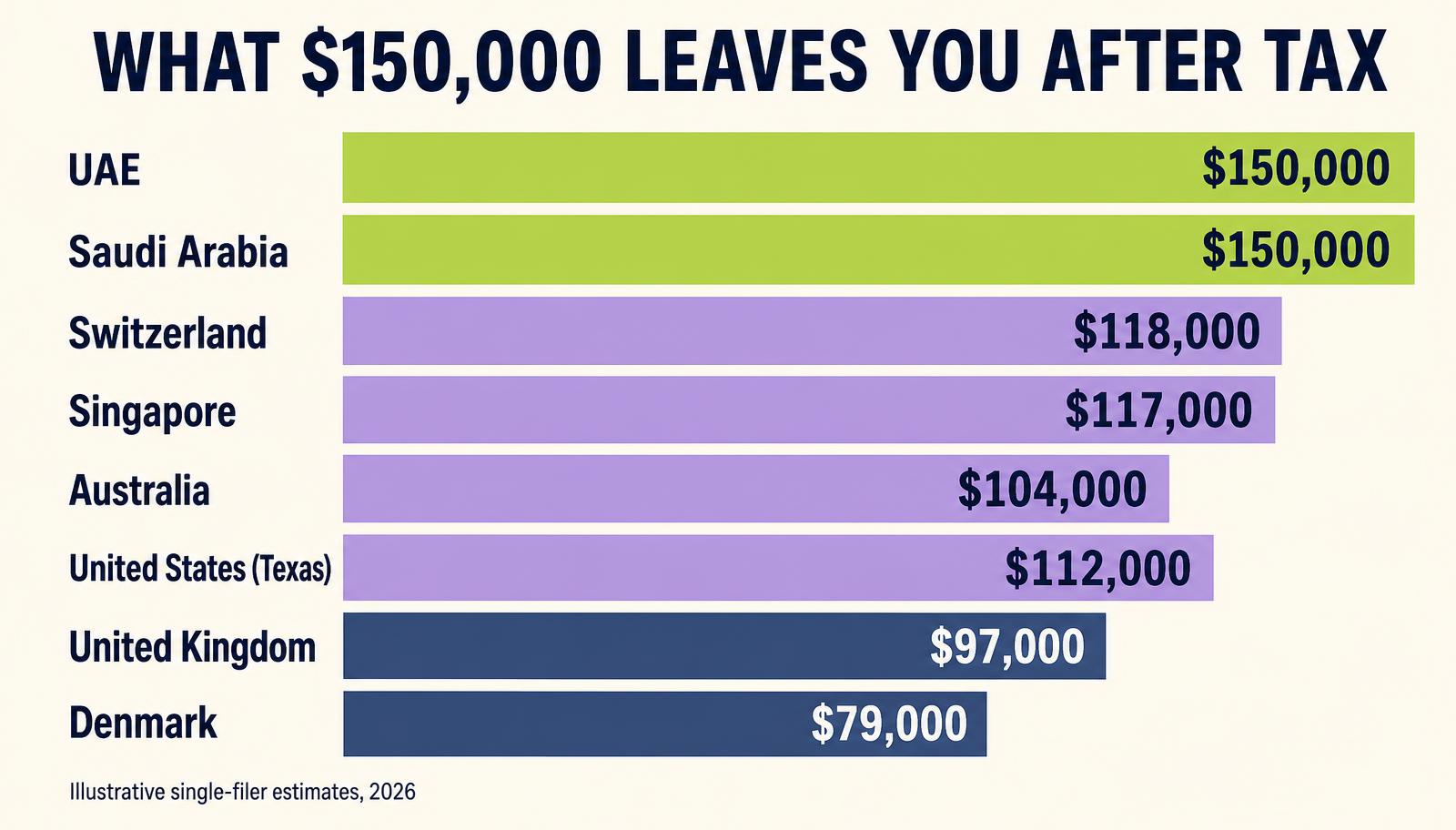
In the UAE, Saudi Arabia and Qatar, the number is unchanged: $150,000 gross, $150,000 taxable-income-free. There is no personal income tax to withhold and no annual filing for employment income.
In the United States, the answer depends on your state before it depends on anything else. In Texas, Florida or Washington a single filer keeps roughly $112,000 after federal tax and FICA. In California the same salary lands closer to $101,000, and in New York City — state plus city resident tax — closer to $99,000. The federal component is identical in all three; the $13,000 spread is purely geography.
In the United Kingdom, £120,000-equivalent income runs into the personal allowance taper above £100,000, producing an effective marginal rate near 60% on that band and a net figure around the mid-$90,000s in dollar terms. In Australia, marginal rates plus the Medicare levy put net pay near $104,000, though superannuation is paid on top of salary rather than deducted from it, which flatters or penalises the comparison depending on whether you count retirement savings as pay.
Switzerland and Singapore both illustrate that you do not need 0% to keep most of your salary. Swiss federal tax is modest and the real variable is your canton and commune — the gap between Zug and Geneva on this salary is larger than the entire UK basic-rate band. Singapore's top rate applies far above this income, so a $150,000 earner keeps a high share while still living in a fully developed legal and banking system.
At the other end, Denmark's combined labour-market contribution, municipal and state tax leaves roughly $79,000 — around half. That is not a criticism; it buys tuition-free university, subsidised childcare and healthcare that a Dubai resident pays for privately or through employer insurance. The comparison is only honest when you count what the tax buys.
- UAE / Saudi Arabia / Qatar: about $150,000 — no personal income tax.
- US (Texas): about $112,000. US (New York City): about $99,000.
- Switzerland: roughly $118,000, but canton choice moves it thousands.
- UK: mid-$90,000s once the £100,000 allowance taper bites.
- Denmark: about $79,000 — roughly half, in exchange for broad public services.
Zero income tax does not mean zero filing — the residency trap
This is the part most listicles omit entirely, and it is the part that costs people money. Whether you owe tax is decided by tax residency, not by where your employer's office is or where your salary is paid.
United States citizens and green card holders are taxed on worldwide income regardless of where they live. Moving to Dubai does not end the filing obligation. The Foreign Earned Income Exclusion shelters a substantial band of earned income for those who meet the physical presence or bona fide residence test, and foreign tax credits handle the rest — but a return is still due every year, along with FBAR and possibly FATCA reporting on foreign accounts. Americans who assume a 0% country means no US filing are the single most common casualty of this topic.
The United Kingdom applies a statutory residence test based on days present, accommodation, work ties and family ties. Leaving mid-year triggers split-year treatment questions, and returning within a short window can pull the intervening period back into scope for some income types.
India taxes residents on global income and applies day-count thresholds, with additional deemed-residence rules for high-income individuals who are not tax-resident anywhere else. The Gulf is the most common destination for Indian professionals, which makes this the most consequential rule set on this page for a large share of readers.
Canada uses a residency-ties test rather than a pure day count, and departure can trigger a deemed disposition of certain assets. Australia's residency tests interact with its own rules on foreign employment income. In every case the principle is the same: you do not become tax-free by arriving somewhere, you become tax-free by ceasing to be tax-resident where you were — and that is a documented process, not a flight.
- US citizens file worldwide, always — FEIE and credits reduce, not remove.
- UK: statutory residence test on days, ties, work and accommodation.
- India: day-count thresholds plus deemed-residence rules for high earners.
- Canada and Australia: ties-based tests, with exit-tax consequences possible.
How to compare an offer properly, in five steps
The mistake almost everyone makes is comparing gross salaries across countries. Gross is meaningless internationally, because tax, mandatory contributions, benefits and employer-paid items differ so much that two identical gross figures can be twenty thousand dollars apart in usable cash.
Step one: convert both offers to net annual pay in a single currency using each country's actual tax rules, not an average rate you read somewhere. Step two: add employer-paid items that you would otherwise buy — health insurance, schooling allowance, housing allowance, annual flights, relocation. In Gulf packages these are frequently worth 20-30% of base salary and are the real reason those offers win comparisons.
Step three: subtract costs the destination forces on you. Rent paid a year in advance, mandatory private health cover for dependants, international school fees, car ownership where public transport is thin, and visa and permit renewals. Step four: adjust for what tax was buying you at home. If you leave a country with tuition-free university and subsidised childcare, part of your old tax bill was a purchase, not a loss.
Step five: consider duration and exit. Zero-tax destinations rarely offer permanent residency or citizenship on employment alone, so treat the package as a fixed-term wealth-accumulation window and ask what happens at the end of it. A five-year stint that saves $200,000 is transformative. The same stint that saves $40,000 after school fees, with no pension accruing anywhere, is a lateral move with extra paperwork.
Run steps one and two through our country calculators before you negotiate, not after. The number that should drive the decision is net cash plus employer-funded benefits minus destination-forced costs — and once you have it, most cross-border offers stop being close calls in either direction.
- Never compare gross salaries across countries — compare net cash.
- Add employer-paid housing, schooling, insurance and flights.
- Subtract forced local costs: advance rent, private health, school fees.
- Credit the services your old tax bill was actually buying.
- Treat 0% postings as a fixed window and plan the exit before you accept.
Who this genuinely works for — and who it does not
Zero-tax relocation works best for a specific profile: high earners with portable skills, few dependants or employer-funded schooling, a strong savings rate, and a defined time horizon. A single engineer or a couple both working, aggressively saving in Dubai or Riyadh for four to six years, can bank a sum that would take fifteen years to accumulate at a 40% effective rate. That is the honest, unglamorous case for it.
It works far less well for mid-income earners, for families paying full international school fees on one salary, for anyone whose profession is licence-bound and non-transferable, and for people who value permanence — residency in most of these jurisdictions ends when employment does.
There is also a version of this decision that ignores borders entirely. Within the United States, moving from California to Texas captures a meaningful share of the same benefit with no visa, no currency risk and no residency test. Within the UK, pension contributions in the £100,000-£125,140 band deliver relief at an effective rate above 60% — a better guaranteed return than most investments and available without moving at all. Optimising where you are is usually the higher-return move, and it is always the faster one.
- Best fit: high earner, portable skill, high savings rate, fixed horizon.
- Poor fit: mid-income, self-funded school fees, licence-bound professions.
- Domestic alternative: no-income-tax US states capture part of the gain.
- UK earners: allowance-taper pension relief beats most relocation maths.