
How Much House Can I Afford on My Salary? Run It on Net Pay, Not Gross
By the Global Income Tax Calculator editorial team · How we source and check these figures
Ask a mortgage calculator how much house you can afford and it will ask for your annual salary. That single question is where most household budgets quietly go wrong, because your salary is not money you have. It is money your employer starts with before income tax, payroll tax, pension contributions and health premiums take their cut.
A lender is comfortable with that gap. Their underwriting is built on gross income and it works reliably at portfolio scale — most people do keep paying. But the person making the payment every month is you, out of net pay, and nobody in the transaction is paid to point out the difference.
This guide rebuilds the standard affordability rules around take-home pay instead. It shows the five separate costs hiding inside the words "mortgage payment", walks three real income levels end to end, and gives you a way to pressure-test a number before an estate agent gives you one.
Why gross-income rules overstate what you can carry
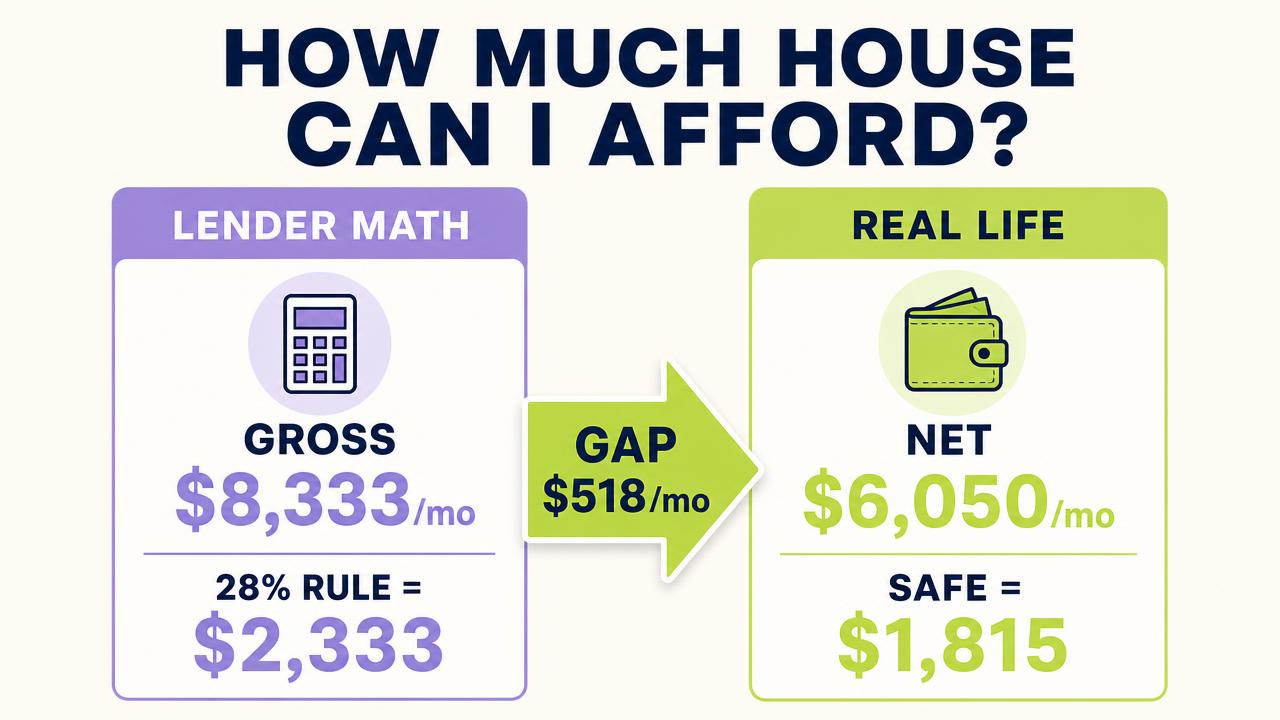
The two rules almost every lender leans on are the 28% rule and the 36% rule: housing costs up to 28% of gross monthly income, and total debt payments up to 36%. On a $100,000 salary that reads as $8,333 a month gross, so $2,333 for housing and $3,000 for all debt combined.
Now look at the same worker's payslip. Federal income tax, Social Security and Medicare, a state income tax in most places, a health premium and a modest retirement contribution routinely remove a quarter to a third of gross pay. Take-home might be $6,000 to $6,300 a month. That $2,333 housing payment is not 28% of the money arriving in the account — it is closer to 38%.
Thirty-eight percent of net pay is not automatically a disaster, but it is a very different life from the one the number implied. It is the difference between a household that saves each month and a household that is one boiler replacement away from a credit card balance. The rule did not lie; it just answered a question about the lender's risk, not yours.
The fix is not a new rule. It is the same rule applied to the correct number: work out your real monthly take-home pay first, then take a percentage of that.
- 28% and 36% are underwriting limits, not personal budgeting advice.
- Income tax and payroll deductions remove roughly 25-33% of gross for typical earners.
- A 28%-of-gross payment is often 35-40% of net pay.
- Apply the percentage to take-home pay and the answer changes materially.
The net-pay method, in four steps
Start with your actual take-home pay for a normal month — not a month with a bonus, not a three-paycheck month. If you are paid fortnightly, multiply one net paycheck by 26 and divide by 12 rather than doubling it, because two of the year's paychecks are extras you should not build a mortgage on.
Second, subtract the commitments that exist whether or not you buy: childcare, student loan payments, car finance, insurance you already carry. What remains is the money genuinely available to be split between housing and living.
Third, apply a target share. A comfortable band is 25% of net pay for housing; 30% is workable if you have a stable job and a real emergency fund; above 35% you are relying on nothing going wrong for several years. Pick the band deliberately rather than discovering it later.
Fourth — and this is the step almost everyone skips — remember the target covers total housing cost, not just the loan. Principal, interest, property tax, insurance, any HOA fee and a maintenance allowance all live inside that one number.
- Use a normal month's net pay, annualised properly.
- Subtract existing fixed commitments before you allocate anything.
- Choose 25% comfortable, 30% workable, 35% stretched — on net, not gross.
- The target is all-in housing cost, not the loan payment alone.
The five costs hiding inside one payment
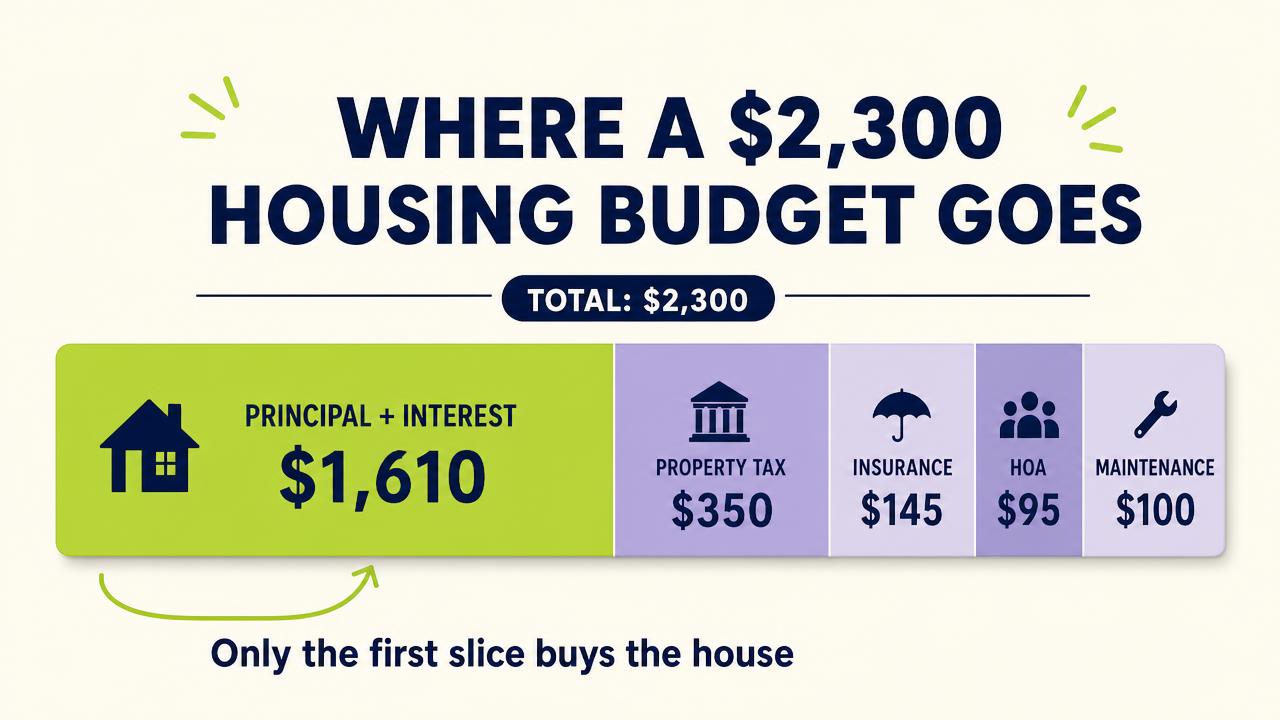
When a listing says a home costs $1,610 a month, that figure is almost always principal and interest only. Property tax adds a few hundred dollars in most of the United States and far more in New Jersey, Illinois or parts of Texas, where a low income tax is partly funded by a high property tax. Homeowners insurance has risen sharply in coastal and wildfire-exposed states. An HOA fee can be $50 or $500.
Then there is maintenance, the cost renters never see. A sensible planning figure is 1% of the home's value a year, which is about $250 a month on a $300,000 house. Some years you spend nothing; the year the roof goes you spend four years' worth at once.
Add those together and a $1,610 loan payment becomes a $2,300 monthly housing cost. If your budget was built on the first number, roughly 30% of your true cost was never in the plan — which is precisely how a comfortable purchase turns into a tight one within a year.
Three worked examples at $60k, $100k and $180k
A single earner on $60,000 in a moderate-tax state takes home roughly $3,900 a month after federal tax, FICA and state tax. At 28% of net that is about $1,090 of all-in housing cost. After property tax, insurance and maintenance, perhaps $760 is left for principal and interest — which supports a loan somewhere near $115,000 at current rates, so a home around $140,000 with a 20% deposit. Gross-based rules would have suggested $1,400 a month and a considerably larger house.
A single earner on $100,000 nets about $6,050 a month. At 30% that is $1,815 all-in, leaving roughly $1,270 for principal and interest — call it a $190,000 loan and a $240,000 home. The lender's 28%-of-gross answer was $2,333, about $518 a month more. That $518 is not imaginary; it is the amount that would have come out of saving, holidays and slack.
A couple earning $180,000 between them nets around $10,600. Higher earners can usually carry a larger share, because the fixed costs of living do not scale with income, so 32% is reasonable: $3,390 all-in, roughly $2,400 for principal and interest, supporting a loan near $360,000. Notice the pattern — as income rises, the gap between the gross rule and the net rule narrows, which is exactly why the gross rules feel accurate to people who are already comfortable.
Every one of these numbers depends on your state, your filing status and your deductions. Run your own salary through the calculator to get the net figure that these percentages should be applied to, then redo the arithmetic with your real number.
- $60k gross: about $3,900 net, roughly $1,090 all-in housing at 28%.
- $100k gross: about $6,050 net, roughly $1,815 all-in at 30%.
- $180k joint: about $10,600 net, roughly $3,390 all-in at 32%.
- Higher incomes can safely carry a higher share because living costs are fixed.
Where you live changes the answer twice over
State tax and property tax pull in opposite directions, and people routinely account for one and forget the other. Texas and Florida charge no state income tax, so the same salary produces a bigger net paycheck — but Texas property tax rates are among the highest in the country, so a chunk of that gain goes straight back out through the housing line.
California and New York take a large bite of income but tax property comparatively lightly relative to value, particularly for long-held homes. The net effect is that two households with identical salaries in different states can afford wildly different homes, and neither the gross-income rule nor a national average captures it.
If you are comparing cities, do it in one currency: monthly money left after tax and after all-in housing cost. That single figure is the honest comparison, and it is often the reverse of what the headline salary suggests.
- No income tax often means higher property tax on the same house.
- Property tax is a permanent cost that rises with assessments, not a one-off.
- Compare cities on money left after tax and after housing, not on salary.
The stress tests worth running before you offer
Run three scenarios on the payment you are considering. First, one income disappears for four months — can the payment be met from savings without new debt? Second, insurance and property tax rise 15% over two years, which is not a pessimistic assumption in several states right now. Third, a $4,000 repair lands in the same quarter as a car problem.
If a payment survives all three without touching a credit card, it is affordable in the sense that matters. If it survives none, the number is a stretch regardless of what any calculator or pre-approval says, and pre-approval is not a verdict on your budget — it is a statement about the lender's appetite.
Also test the payment before you commit to it. Set the difference between your current rent and the proposed all-in housing cost aside every month for three months. It is a genuinely informative exercise: either the money is simply there, or you learn something important about the plan before it is irreversible.
- Test one income lost for four months.
- Test a 15% rise in insurance and property tax.
- Test a repair and a car bill in the same quarter.
- Bank the rent-to-mortgage difference for three months as a live rehearsal.
The takeaway
Affordability is not a number a lender hands you. It is a share of the money that actually reaches your account, after every deduction, and it has to cover five costs rather than one. Getting those two adjustments right typically moves the answer 15-25% below the figure a gross-income calculator produces.
That is not a reason to buy less house out of caution. It is a reason to buy the right house with your eyes open, because the households that regret a purchase almost never chose the wrong home — they chose the right home against the wrong income number.
Start with the net figure. Everything downstream of it is arithmetic you can do in ten minutes.