
No Tax on Overtime: What the Deduction Actually Takes Off Your Paycheck
By the Global Income Tax Calculator editorial team · How we source and check these figures
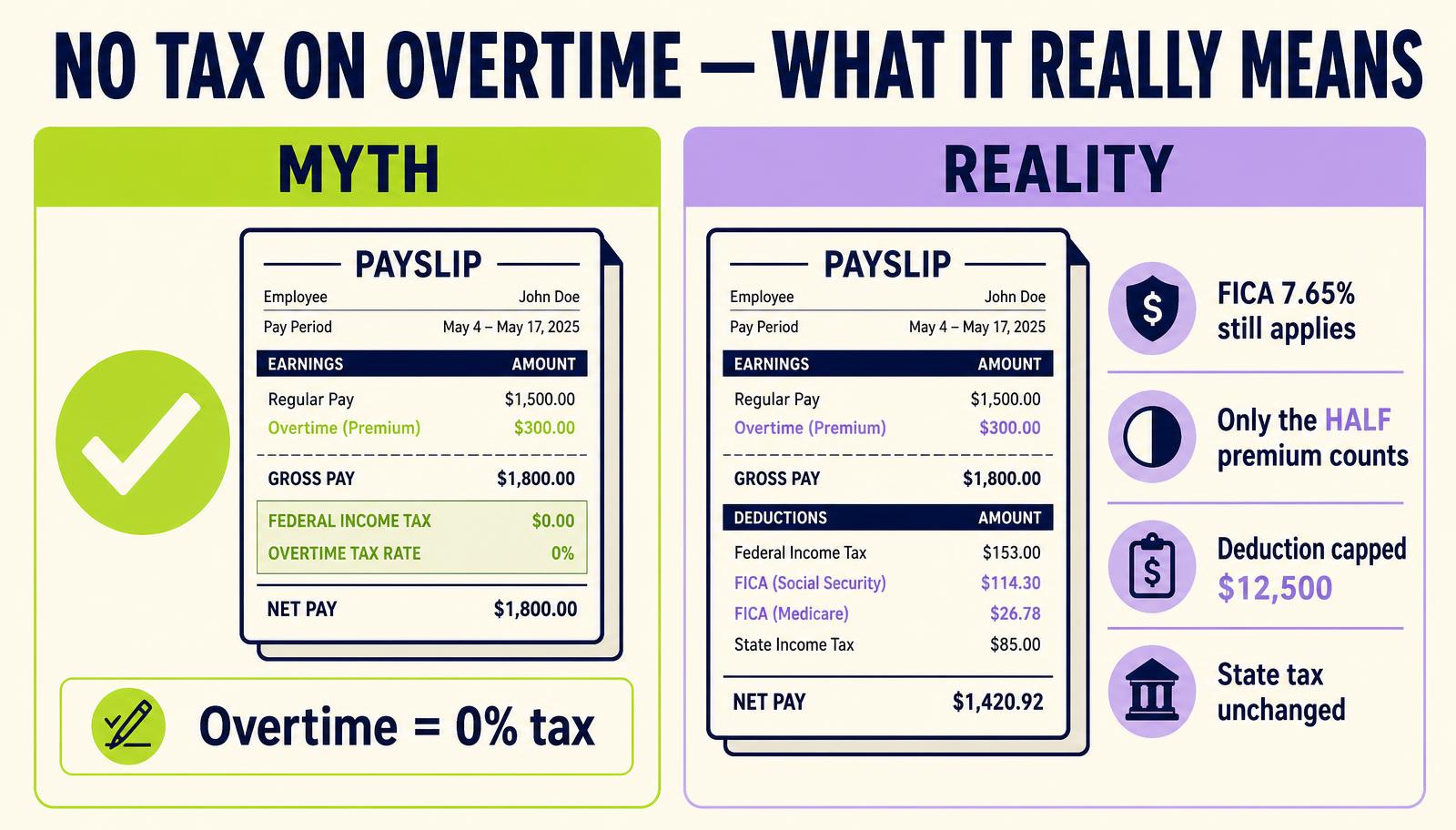
If you work overtime, you have probably heard some version of this: overtime is tax-free now. A supervisor said it, a group chat repeated it, and the phrase "no tax on overtime" is searched well over a hundred thousand times a month. Then payday arrives, the deductions look almost identical to last year, and it feels like someone lied.
Nobody lied exactly, but the shorthand is badly wrong in three separate ways. The relief is a deduction claimed on your return, not an exemption applied to your paycheck. It covers only a slice of your overtime — the premium half, not the full amount. And it touches federal income tax only, leaving Social Security, Medicare and state tax completely untouched.
This guide does the part almost nobody does: it walks a real overtime cheque line by line, shows what the deduction is worth in dollars at a few income levels, and explains why your withholding may not change at all even when your refund does.
A deduction is not the same thing as being untaxed
An exemption means money never enters your taxable income. A deduction means the money is taxed as normal all year, and then you subtract an amount at filing time so that some of the tax comes back. The overtime relief is the second kind, which is why your paycheck can look unchanged while your refund grows.
That distinction decides what the relief is worth to you. A deduction saves you tax at your marginal rate, not at 100%. If your top bracket is 22%, a $1,000 deduction is worth roughly $220 in your pocket — not $1,000. Anyone expecting their whole overtime payment to arrive intact has mentally applied a 100% saving to a 22% benefit.
It also means timing matters. Overtime worked in January does not pay you back until you file the following year. If you are counting on overtime to cover a bill this month, budget on the withheld number your payroll system actually produces, not the headline.
- Exemption: income is never taxed. Deduction: tax is paid, then partly refunded.
- Value equals your marginal rate, so roughly 12c, 22c or 24c per dollar deducted.
- The benefit usually arrives at filing time, not on the paycheck.
- Your withholding may be unchanged all year and still be correct.
Only the premium half of overtime qualifies
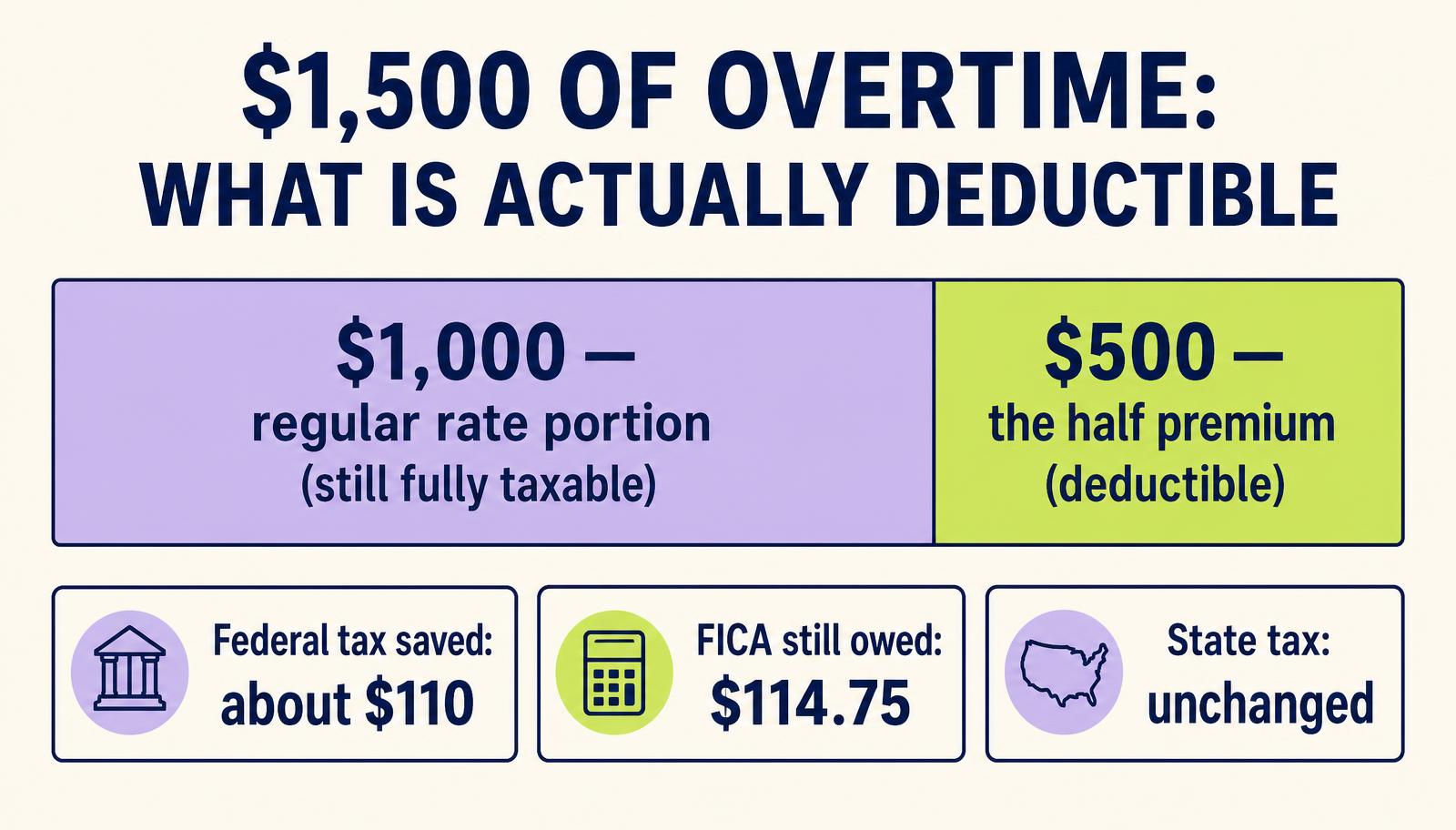
This is the detail that surprises people most. Overtime under the Fair Labor Standards Act is paid at one and a half times your regular rate. That payment splits conceptually into two parts: the regular-rate portion you would have earned for those hours anyway, and the extra half on top. The deduction applies to the extra half only.
Work 10 hours of overtime at a $30 regular rate and you are paid $45 an hour, so $450. Of that, $300 is the regular-rate portion and $150 is the premium. Your deductible amount for those hours is $150, not $450. At a 22% marginal rate the relief is worth about $33 for the week — genuinely useful across a year of steady overtime, and nothing like a tax-free paycheck.
There is a second filter too. The relief is designed around overtime that federal law requires your employer to pay. Extra pay from a union contract that is more generous than the legal minimum, weekend or shift differentials, double-time bonuses and holiday premiums do not automatically count just because they arrive as extra money. If your pay stub lumps every kind of premium into one "OT" line, the qualifying number is smaller than that line suggests.
FICA and state tax do not move at all
Social Security and Medicare are charged on gross wages, and the overtime deduction does not reduce gross wages. Every qualifying dollar of overtime still pays 6.2% Social Security up to the annual wage base and 1.45% Medicare with no cap — 7.65% combined. On $5,000 of overtime across a year, that is $382.50 that no deduction touches.
State income tax is its own system with its own definition of taxable income. Most states start from federal figures but choose which federal deductions to follow, and several deliberately decouple from new federal provisions. Unless your state legislature specifically adopts the overtime deduction, your state withholding on overtime stays exactly where it was.
So the realistic best case on a dollar of qualifying premium pay is that you keep your marginal federal rate — call it 22c — and still hand over 7.65c to FICA plus whatever your state charges. In a 5% state you are keeping about 73c of that dollar instead of 65c. Better, but not free.
- Social Security 6.2% and Medicare 1.45% apply to overtime regardless.
- State income tax follows state rules and often ignores the federal deduction.
- Nine states charge no income tax, so the federal relief is the whole story there.
- The practical improvement is a few cents per dollar, not the full amount.
The caps and the income phase-out
The deduction is capped at $12,500 of qualifying premium pay for a single filer and $25,000 for a married couple filing jointly. Because only the half premium counts, hitting the single cap takes roughly $37,500 of total overtime payments in a year — a lot of hours, but not unheard of in trades, healthcare, logistics and manufacturing during a busy stretch.
There is also an income test. The benefit begins to shrink once modified adjusted gross income passes about $150,000 for a single filer and $300,000 for a joint return, and it tapers away above that. This is the quiet reason a high-earning couple with heavy overtime can conclude the relief "does not exist" while a single earner on $58,000 sees a clear difference in their refund.
Married filing separately is worth a moment's thought if one spouse does all the overtime, because the caps and thresholds are not simply halved in effect once other credits are in play. That is a genuine run-the-numbers-both-ways situation rather than a rule of thumb, and it is one of the few places where an hour with a preparer pays for itself.
A worked year: 10 overtime hours a week on $30 an hour
Take a single filer with a $30 regular rate, 40 standard hours a week, and 10 hours of overtime every week for 48 weeks. Base wages are about $57,600. Overtime pays $45 an hour, so 480 overtime hours brings in $21,600 gross, for total wages of roughly $79,200.
Of that $21,600, the premium half is $7,200 — comfortably under the $12,500 cap, so all of it qualifies. At a 22% marginal rate the deduction saves about $1,584 in federal income tax. Meanwhile FICA on the full $21,600 of overtime is $1,652, and a 5% state takes $1,080 of it. Nothing about those two numbers changes.
So the honest summary for this worker is: overtime added about $21,600 of gross pay, roughly $15,000 of it survived to the bank account before the deduction, and the deduction returns about $1,584 of that at filing time. That is a real, meaningful raise on the year — a fortnight's take-home pay, effectively — and it is a completely different story from "my overtime is untaxed."
Run your own version rather than trusting the example. Put your total expected wages including overtime into the US calculator to see the withholding reality, then subtract your premium half from taxable income and run it again. The gap between the two results is your actual benefit, in your bracket, in your state.
- Total wages: about $79,200 including $21,600 of overtime.
- Qualifying premium half: $7,200, under the $12,500 cap.
- Federal tax saved at 22%: roughly $1,584 at filing time.
- FICA on overtime: about $1,652, unchanged by the deduction.
How to make sure you can actually claim it
The single biggest practical risk is documentation. To deduct the premium half you need to know what the premium half was, and many payroll systems have historically shown overtime as one blended line. Employers are moving toward reporting qualifying overtime separately, but transition years are messy and small employers are often last.
Check your next pay stub for a line that separates the premium from the regular-rate portion. If it is not there, ask payroll — politely and early — whether they intend to report qualifying overtime separately on your year-end statement. Asking in August is a request; asking in March is a problem.
In the meantime, keep your own record. A simple monthly note of overtime hours and your regular rate is enough to reconstruct the premium half, and it costs you two minutes. Also remember this is a below-the-line deduction you claim on the return, so it does not require itemising — you can take the standard deduction and still claim it.
- Look for overtime premium reported separately on stubs and year-end forms.
- Ask payroll before year end, not at filing time.
- Log overtime hours and your regular rate monthly as a backup.
- You can claim it without itemising.
The point of view worth taking away
The headline oversold this and the backlash undersold it. "No tax on overtime" is not true, and the people telling you it changes nothing are also wrong: a shift worker with steady hours is looking at a four-figure improvement on the year, which is a real pay rise that arrives with no negotiation and no job change.
What it does not do is change the decision-making arithmetic much. Overtime was worth taking or refusing based on the roughly 70 cents on the dollar you kept before, and now it is worth roughly 73 to 78 cents depending on your bracket and state. If an extra ten hours a week was not worth it last year, this does not tip the scale. If it was, you now keep a little more of it.
Treat the relief as a rebate on work you were already doing rather than a reason to do more of it. Then verify your own number instead of the internet's, because the only figures that matter are your rate, your hours, your bracket and your state.