
States With No Income Tax: What Moving to Texas or Florida Actually Saves You
By the Global Income Tax Calculator editorial team · How we source and check these figures
There are two ways to cut your US tax bill. One is to spend a weekend with a spreadsheet, a 401(k) form and an HSA. The other is to change your address. The second one is bigger, and it is the reason "states with no income tax" gets searched hundreds of thousands of times a month by people who are only half joking about leaving.
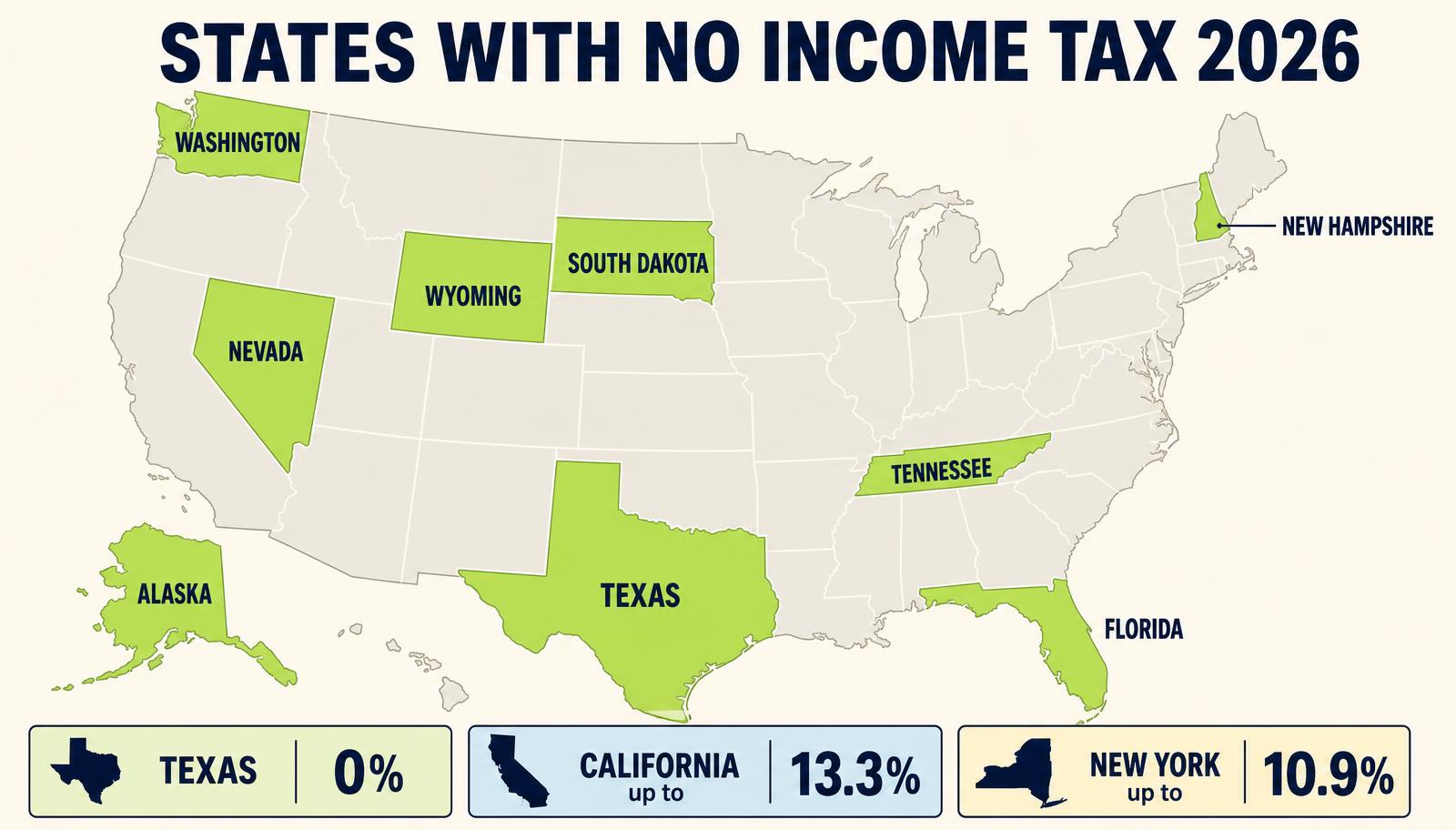
Nine states charge no tax on wage income in 2026: Alaska, Florida, Nevada, New Hampshire, South Dakota, Tennessee, Texas, Washington and Wyoming. That part of the story is simple and every article repeats it. What almost none of them do is finish the arithmetic — because a state that skips income tax still funds its schools, roads and courts, and it collects the money from somewhere you will feel.
This guide runs the whole calculation. First the real saving at three income levels. Then the property, sales and excise taxes that take a chunk of it back. Then the residency rules that decide whether the state you left agrees you have actually left — which is where most of the expensive mistakes happen.
The nine states with no income tax in 2026
Seven states have never taxed wage income at all: Alaska, Florida, Nevada, South Dakota, Texas, Washington and Wyoming. Two more finished phasing theirs out recently. Tennessee ended its tax on interest and dividends in 2021, and New Hampshire completed the same phase-out at the start of 2025, which is why older articles still list them with an asterisk. Both are now genuinely 0% on personal income.
A few caveats matter if your income is not a straightforward salary. Washington charges a 7% capital gains tax on long-term gains above roughly $270,000 per year, so it is 0% on your paycheck but not on a large stock sale. New Hampshire still taxes business profits at the entity level, which affects some self-employed filers. And every one of the nine still sits under the federal system — you owe federal income tax and FICA wherever you live, and that is the majority of most people's bill.
It is also worth naming the near-misses, because several states are close enough that the comparison changes the ranking. North Dakota, Arizona, Indiana and Pennsylvania all charge flat or near-flat rates between roughly 2% and 3.1%. On a $120,000 salary that is a difference of a few thousand dollars a year — meaningful, but far smaller than the gap to California's top brackets, and often smaller than the property-tax difference between two suburbs in the same metro.
- No tax on wage income: AK, FL, NV, NH, SD, TN, TX, WA, WY.
- Washington: 0% on wages, 7% on long-term capital gains above ~$270k.
- New Hampshire finished its interest-and-dividends phase-out in 2025.
- Federal income tax and FICA apply in all 50 states regardless.
- Low-flat-tax states (2%–3.1%) are close competitors, not distant ones.
What you actually save: $60k, $120k and $250k compared
Here is the number people are really searching for. These are 2026 estimates for a single filer taking the standard deduction, with no dependants and no state-specific credits, comparing a no-income-tax state against California and New York City.
At $60,000, a Texas resident pays roughly $5,400 in federal income tax and $4,590 in FICA, keeping about $50,000. The same earner in California adds around $1,800 in state tax; in New York City, state plus city tax adds around $3,300. So at this income the move is worth $1,800 to $3,300 a year — real money, but easily erased by a $300-a-month rent difference.
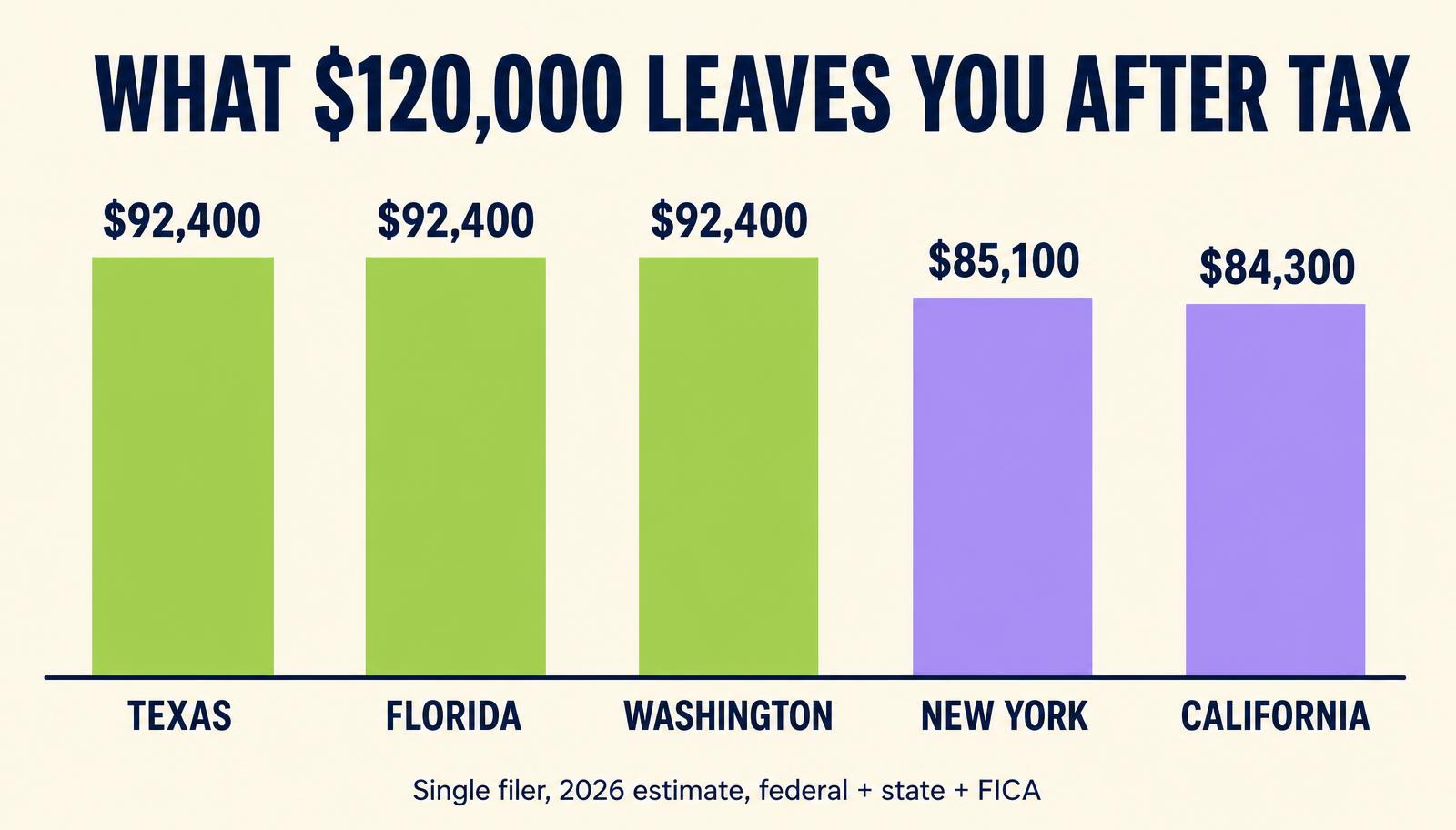
At $120,000, the gap widens sharply because state brackets are progressive too. Texas leaves about $92,400. California takes roughly $8,100 in state tax, landing near $84,300. New York City residents pay around $7,300 combined, landing near $85,100. The move is now worth $7,000 to $8,000 a year, which is where relocation starts to look like a genuine financial decision rather than a rounding error.
At $250,000, the arithmetic becomes hard to ignore. California state tax on that income is roughly $21,000 and New York City's combined bite is close to $19,500, while Texas, Florida and Washington take nothing. That is a $19,000–$21,000 annual swing on the same job and the same federal return — enough to fund a mortgage payment, a full 401(k) contribution or a child's tuition every single year.
The pattern is the point: the benefit scales with income and is close to worthless at the bottom. Below roughly $50,000, state income tax is a small line and no-tax states often recover more than that from you through sales and property tax. Above roughly $150,000, the saving is large, compounding and difficult to replicate through any deduction you could claim instead.
- $60,000: saves roughly $1,800 (vs CA) to $3,300 (vs NYC) a year.
- $120,000: saves roughly $7,000–$8,100 a year.
- $250,000: saves roughly $19,500–$21,000 a year.
- Below ~$50,000 the saving is often cancelled by sales and property tax.
- Above ~$150,000 it is the single largest legal tax lever most earners have.
What replaces it: property tax, sales tax and the hidden clawback
Every no-income-tax state funds itself another way, and the substitutes are not gentle. Texas has some of the highest effective property tax rates in the country — commonly 1.6% to 2.3% of assessed value depending on the county and school district. On a $450,000 house that is $7,200 to $10,300 a year, which can wipe out the entire income-tax saving for a $120,000 earner who buys rather than rents.
New Hampshire runs the same trade in a colder climate: no income tax, no sales tax, and property tax rates that regularly exceed 1.8%. Washington leans hard on sales tax instead, with combined state and local rates around 10% in Seattle, and Tennessee is similar at close to 9.5% — the highest average combined sales tax in the country. Nevada blends high sales tax with heavy tourism and gaming revenue, which is why residents feel it less than the rate card suggests.
Alaska is the outlier in both directions. No income tax, no state sales tax, and residents receive an annual Permanent Fund Dividend from oil revenue. The offsets are cost of living, freight-inflated grocery prices and limited services in much of the state — a genuine 0% jurisdiction with a geography-shaped catch.
The practical rule is this: no-income-tax states shift the burden from what you earn to what you own and what you buy. That is excellent news for a high earner who rents, saves aggressively and buys little. It is far less compelling for a middle-income family buying a house in a high-millage Texas school district — for them the switch can be close to neutral, or slightly negative.
- Texas: effective property tax often 1.6%–2.3% of home value.
- New Hampshire: no income or sales tax, property rates above 1.8%.
- Tennessee ~9.5% and Seattle ~10% combined sales tax.
- Alaska pays residents a dividend but freight costs inflate everything.
- The burden moves from income to property and consumption — model both.
Residency is a test, not a postcode
This is the part that costs people the most, and it is barely covered in the usual listicles. High-tax states do not simply accept that you left. California, New York and New Jersey run some of the most aggressive residency audits in the country, and the burden of proof sits with you.
Two separate rules can pull you back in. Statutory residency generally applies if you keep a permanent home in the state and spend more than 183 days there in the year — and a day usually counts if you were present for any part of it, including a landing at JFK. Domicile is the harder test: it asks where your true, permanent home is, judged on where your family lives, where your driver's licence and voter registration sit, where your doctors and dentists are, where your cars are registered, where your professional licences are held, and where you spend holidays.
Remote workers face a second trap. If you live in Florida but your employer is in New York and you occasionally work from their office, New York can tax the income earned on those days — and under its convenience-of-the-employer rule, in some circumstances it taxes days you worked remotely too. Several states apply a similar convenience rule, and it has caught out a great many people who assumed a Florida address settled the question.
If you are moving specifically for the tax saving, treat the paperwork as part of the move rather than an afterthought. Change your licence, registration and voter registration promptly. Keep a day-count log with evidence. Sell or genuinely rent out the old home rather than keeping it available. File a final part-year return in the old state. And if the amount at stake is $20,000 a year, spend a few hundred dollars on a CPA who has handled a residency audit before — the asymmetry is enormous.
- 183-day statutory residency: partial days usually count as full days.
- Domicile is judged on licence, voting, family, doctors and vehicles.
- Convenience-of-the-employer rules can tax remote days for some states.
- Keep a day log, change registrations early, file a part-year return.
How to decide, in five honest steps
Step one: calculate your current federal, state and FICA burden and your net pay, then recalculate it with the state line set to zero. That difference — not the state's top marginal rate — is the actual prize. Our US and state calculators do this in a few seconds, and a $60,000 earner is often surprised by how small the number is.
Step two: subtract the property tax on the house you would actually buy, not a state average. County appraisal districts publish rates; a Dallas suburb and an Austin suburb can differ by half a percent, which is thousands of dollars a year on the same house price.
Step three: add the sales-tax difference on your real spending. A household spending $45,000 a year on taxable goods pays about $1,600 more at a 10% combined rate than at 6.5%. Small, but it belongs in the model.
Step four: adjust for salary, not just tax. Many roles are benchmarked to local markets, so the same job may pay 10% to 20% less in Nashville than in San Jose. A 9% tax saving on a 15% pay cut is a loss, and this single factor reverses more relocation decisions than any tax rule does.
Step five: price the things a spreadsheet resists — commute, climate, childcare cost and availability, health-system access, and how far you now live from people you would drop everything for. Tax is the easiest variable to quantify, which is exactly why it gets over-weighted in decisions like this.
Run steps one through three before you talk to a recruiter, and the conversation changes: you stop negotiating gross salary and start negotiating the number that actually reaches your account.
- Compute net pay with and without the state line — that is the real prize.
- Use the actual county property tax rate, not a state average.
- Add the sales-tax delta on your genuine annual spending.
- Check local salary benchmarks: a pay cut can outweigh the tax saving.
- Include commute, childcare, healthcare and distance from family.
Who this works for — and who should stay put
It works best for high earners with portable, remote-friendly or nationally-benchmarked pay: software, finance, sales, consulting, medicine in shortage specialities. Someone earning $250,000 who can hold their salary while moving from San Francisco to Austin or Miami is capturing roughly $20,000 a year with no change to how they work. Over ten years, invested, that is a house deposit or an early retirement date.
It works for people about to realise a large one-off gain too — a business sale, a big equity vest — though the timing rules are strict and state-specific, and this is exactly the scenario where a residency audit is most likely. Get advice before the transaction, not after.
It works poorly for middle-income earners buying property in high-millage districts, for anyone whose salary is set locally and would fall with the cost-of-living index, and for licence-bound professionals who would need to requalify. It also works poorly as a rushed decision: the tax saving arrives every year for as long as you stay, so an extra three months spent modelling it properly costs almost nothing.
And if moving is not on the table, the domestic version of the same logic still pays. Maxing a 401(k) and an HSA reduces both federal and state taxable income, which is worth more in California than in Texas — the higher your state rate, the more every pre-tax dollar saves you. Optimising where you already live is slower, less dramatic, and available to everyone.
- Best fit: $150k+ earners with portable or nationally-benchmarked pay.
- Strong fit: planning a large one-off gain — but get advice first.
- Poor fit: locally-benchmarked salaries, high-millage home purchases.
- No move needed: pre-tax contributions save most in high-tax states.