
The Same $100,000 Salary in the US, UK and Germany: What You Actually Keep
By the Global Income Tax Calculator editorial team · How we source and check these figures
Relocation conversations almost always stall on the same sentence: "the package is about the same." It rarely is. Three payroll systems can start from an identical gross salary and hand over amounts that differ by the price of a small car every year — and the ranking flips again once you count what each country charges you separately for health cover, pensions and childcare.
This comparison takes one worker, one salary equivalent to roughly $100,000, and runs it through the American, British and German systems as a single employee with no children, no unusual deductions and no clever structuring. Then it puts the missing costs back in, because a net-pay number on its own is a half-answer.
Currency conversions here use round working rates (£1 ≈ $1.27, €1 ≈ $1.08) so the shapes stay comparable. Treat every figure as a well-grounded estimate for planning, not a payslip.
The headline: three nets from one gross
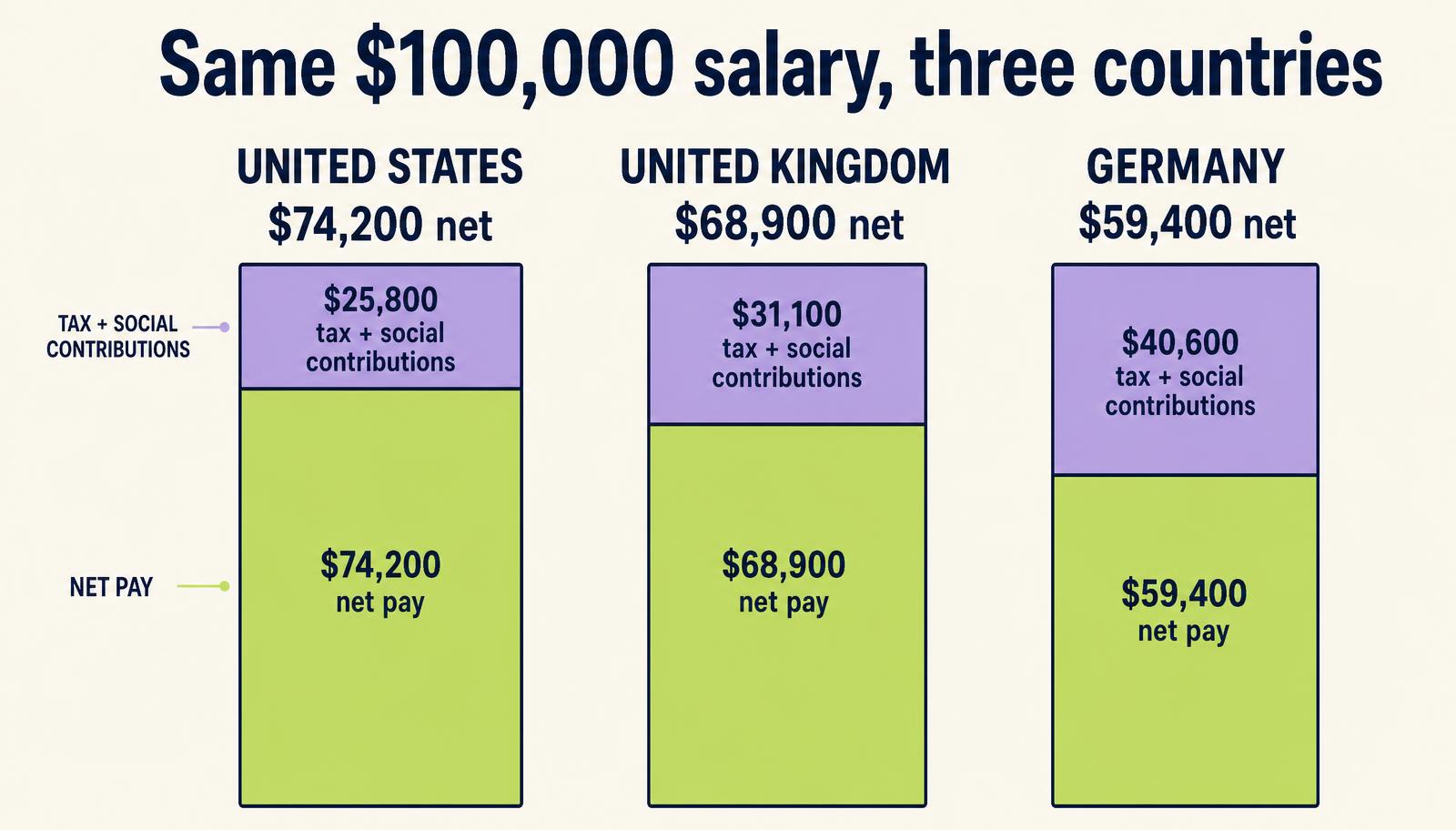
On a $100,000 salary, a single filer in a mid-tax American state keeps roughly $74,200 after federal income tax, state income tax and FICA. The same job in London, paying about £79,000, leaves roughly £54,300 after income tax and National Insurance — around $68,900. In Berlin, at about €92,500, the take-home lands near €55,000, or roughly $59,400 once you convert.
That is a spread of nearly $15,000 between the top and bottom, on identical gross pay. Nothing exotic is happening: the difference is almost entirely how much of the cost of health cover and retirement each country collects through payroll rather than leaving to you.
The American number is highest partly because it is the least complete. Out of that $74,200, a typical worker still pays health insurance premiums, funds their own retirement, and covers deductibles when they use care. Germany's smaller net has already bought most of those things.
- United States: about $74,200 net (mid-tax state, single, standard deduction).
- United Kingdom: about £54,300 net, roughly $68,900.
- Germany: about €55,000 net, roughly $59,400.
- Same gross, ~$15,000 spread — and the largest net is the least inclusive.
Why the American number looks so good on paper
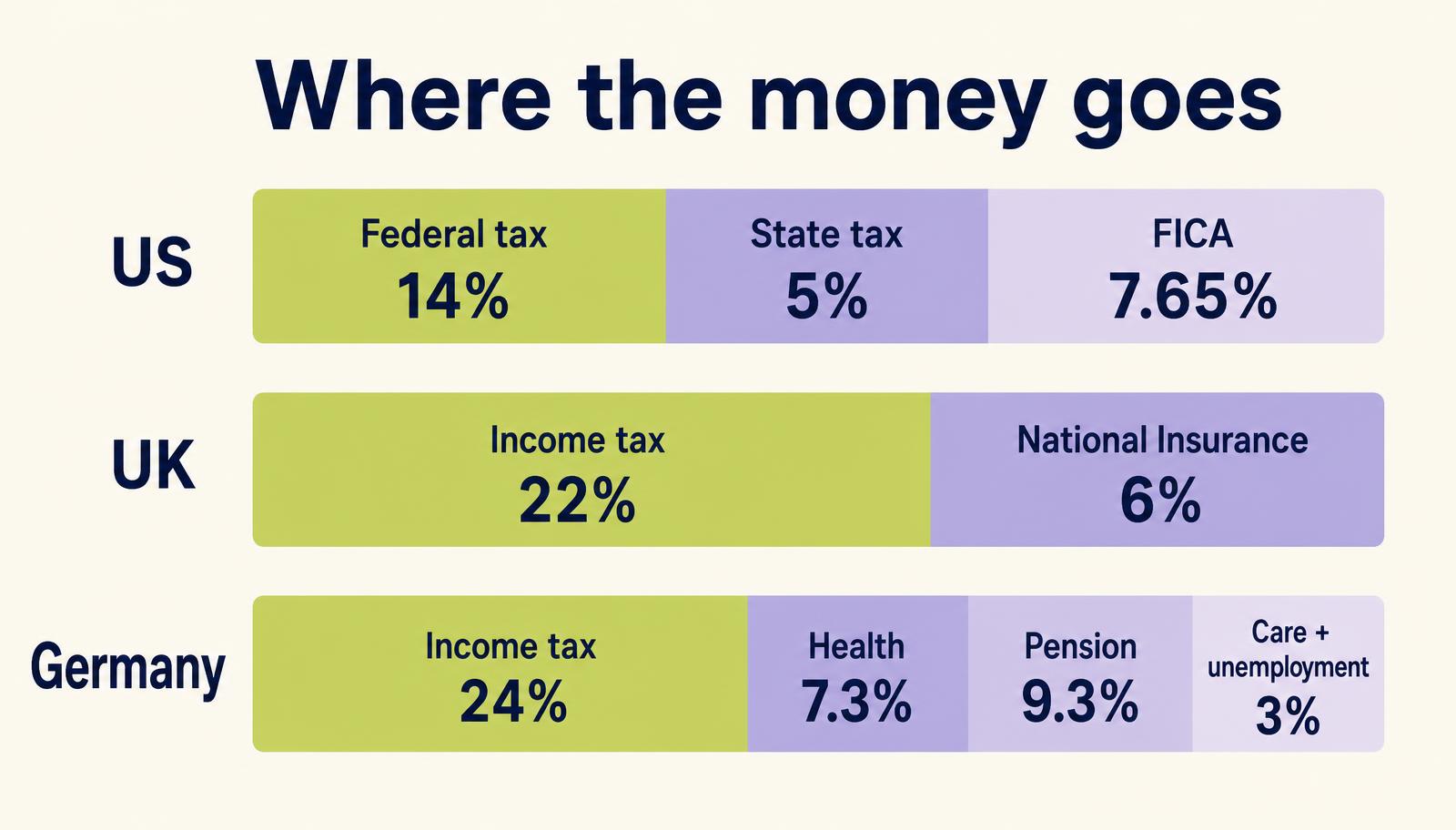
Federal income tax on $100,000 for a single filer is not the 24% bracket people quote. Brackets apply to slices, and the standard deduction removes a chunk of income before any of them bite, so the effective federal rate sits closer to 14%. Add FICA at 7.65% on almost the whole salary, and a state income tax somewhere between zero and about 6% depending on where you sign the lease.
The trap is the word "net". American net pay is a pre-health-care number in a way British and German net pay is not. Employer-sponsored coverage still costs the employee an average of well over $1,500 a year for single cover, and family cover multiplies that several times over. Deductibles and coinsurance sit on top when you actually use the system.
Then there is retirement. Social Security replaces a smaller share of pre-retirement income than the German statutory pension, which is why a 401(k) contribution is treated as normal rather than optional. Divert 8% of a $100,000 salary and the comfortable $74,200 becomes closer to $66,000 of spendable money — before a single premium is paid.
None of this makes the American offer worse. It makes it a different kind of offer: more money in your hands, more decisions on your desk, and more variance in the outcome depending on health, employer plan quality and state.
The UK sits in the middle, with two odd cliffs
British payroll is the simplest of the three: income tax in bands of 20%, 40% and 45%, plus employee National Insurance at 8% and then 2% above the upper earnings limit. On £79,000 that produces an effective total deduction near 31%, and a net figure that lands between the American and German results.
Two features distort the picture at specific incomes. The first is the personal allowance taper: between £100,000 and £125,140 the tax-free allowance is withdrawn at £1 for every £2 earned, producing an effective marginal rate around 60% on that band. A £110,000 offer can therefore be worth surprisingly little more than a £100,000 one.
The second is the way National Insurance drops to 2% above £50,270. Cross that line and the combined marginal rate moves from 28% to 42% rather than from 28% to 48%, which is why the higher-rate threshold feels less punishing in practice than in headlines.
Health care is not a payroll line item beyond NI, and workplace pension auto-enrolment takes a further 5% of qualifying earnings by default. That contribution is real money out of net pay, so a British take-home figure quoted without it is a little flattering too.
- Effective UK deduction on ~£79,000: roughly 31% of gross.
- £100,000–£125,140 carries an effective marginal rate near 60%.
- NI falls to 2% above £50,270, softening the higher-rate jump.
- Auto-enrolment pension contributions come out after this calculation.
Germany takes the most and gives the most back
German payroll is where the deduction list gets long. Income tax runs on a continuous formula rather than flat bands, reaching 42% at around €68,000 of taxable income. On top of it sit four social insurance contributions: statutory health at roughly 7.3% plus a supplementary rate, long-term care at about 1.8%, pension at 9.3%, and unemployment insurance at 1.3% — each employee share matched by the employer.
Church tax adds 8–9% of the income tax figure for registered members, and the solidarity surcharge still applies at higher incomes. Together this is why a €92,500 salary produces the lowest net of the three.
What that buys is a genuinely different risk profile. Health cover for the employee and dependants with no premium per family member, statutory sick pay, parental allowance, subsidised childcare in most cities, and a pension that replaces a meaningfully larger share of pre-retirement income than Social Security does. A German household earning this salary spends far less out of pocket on the things an American household budgets for separately.
The tax class system also matters more than expat forums suggest. A married single-earner in class III can take home noticeably more than the same person in class I, because the tax tables assume the couple's allowances. If you are comparing offers as a couple, the class assumption changes the answer before any negotiation does.
Putting the hidden costs back in
Compare the three nets after the costs each system leaves to the individual, and the gap narrows sharply. Strip a realistic health premium and an 8% retirement contribution from the American figure and it lands near $66,000 of genuinely discretionary money with health-care risk still attached. Take auto-enrolment out of the British figure and it sits near $65,000 with no such risk. The German figure barely moves, because most of it was already deducted.
That is the real finding of this exercise: the ranking by net pay and the ranking by financial security are not the same list. The US wins on cash, Germany wins on downside protection, and the UK sits between the two on both counts.
Cost of living then reshuffles everything again. Berlin rents remain well below London and most large American metros, so a lower German net can support a higher standard of living than the raw conversion implies. Chicago and Manchester will each tell their own story.
How to compare an actual offer in fifteen minutes
Start by converting each offer to net pay in its own currency using a calculator built for that country's rules, not a generic percentage. Then subtract the items that country leaves to you: health premiums and retirement in the US, workplace pension in the UK, very little in Germany.
Next, divide by a local cost basket rather than an exchange rate — rent for the flat you would actually take, transport, groceries, childcare if relevant. A 12% lower net against 25% lower housing costs is a raise, not a cut.
Finally, price the tail risks. What happens to your income if you are ill for three months? What does one hospital admission cost? What does a year of parental leave do to household cash flow? These questions rarely appear in an offer letter and they routinely decide which move people are glad they made five years later.
- Convert each offer to net pay under local rules first.
- Subtract what each country leaves to you (health, pension).
- Divide by a real local cost basket, not the exchange rate.
- Price illness, parental leave and one bad health year explicitly.
The takeaway
One $100,000 salary produces about $74,200, $68,900 and $59,400 of net pay in the US, the UK and Germany respectively — and once the costs each system does not collect are added back, those three numbers land within about $8,000 of each other with very different amounts of risk attached.
So the useful question is not "which country taxes least?" It is "which country charges me for the things I would have to buy anyway, and how much variance can my household absorb?" Answer that, and the offer that looked worse on the spreadsheet is often the one worth taking.
Run your own numbers before the conversation, not after. The calculators for each country will get you to a defensible figure in a couple of minutes.